Executive Summary
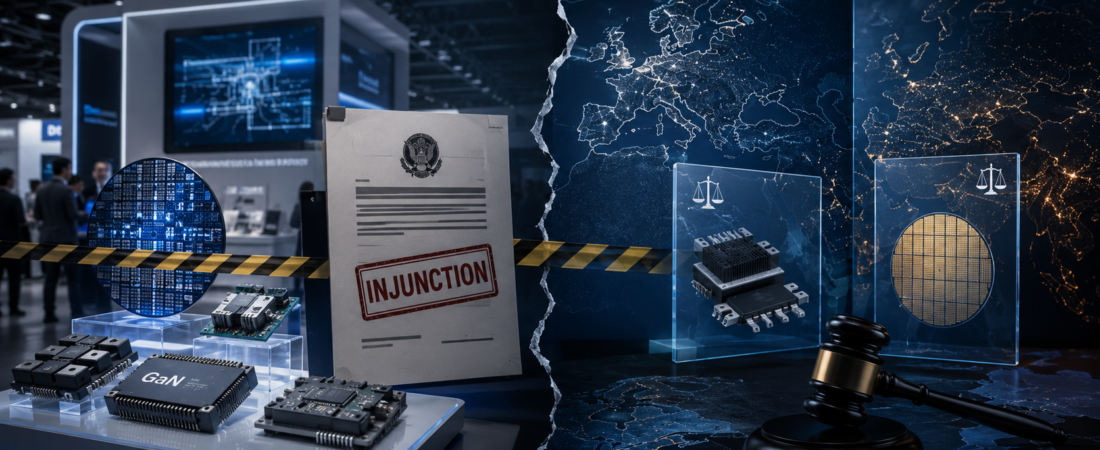
A reported patent clash between China’s Innoscience and Germany’s Infineon Technologies at electronica Shanghai 2026 has become a revealing test case for the global gallium nitride, or GaN, semiconductor market. According to Digitimes, Innoscience used a Chinese court injunction to make Infineon remove GaN power products from its exhibition display, turning a legal dispute into a highly visible commercial disruption.
The episode matters beyond the two companies involved. GaN is an increasingly important power semiconductor technology for fast chargers, industrial systems, electric vehicles, and data center power delivery. That gives the dispute relevance to both Asia’s electronics supply chain and the buildout of AI infrastructure, where power efficiency is becoming more important as computing density rises.
The strategic significance is not simply that a patent case occurred. It is that a Chinese company was reportedly able to use a domestic court order to constrain a foreign rival at a major China industry event. That may indicate a shift in how intellectual property disputes affect market access in advanced semiconductor segments.
According to the available source information, there are also reported parallel proceedings outside China that do not point to a single globally settled outcome. If that pattern holds, semiconductor companies may increasingly face a fragmented legal environment in which a product position that is defensible in one jurisdiction becomes vulnerable in another. For Asia-focused technology investors and industry planners, the key takeaway is that wide-bandgap power semiconductors are becoming strategically contested not only through product development and manufacturing scale, but also through litigation, venue choice, and local enforcement.
Watch the Short Brief
This short explains why the Innoscience-Infineon dispute may signal a broader shift in how Chinese courts shape competition in the global GaN semiconductor market.
Key Developments
According to Digitimes, the immediate flashpoint was electronica Shanghai 2026, where a patent dispute between Innoscience and Infineon moved from the courtroom to the exhibition floor. The report says Innoscience secured a Chinese court injunction that resulted in Infineon removing GaN power products from display. That made the case unusually public for what might otherwise have remained a technical legal dispute.
The available information does not establish all underlying procedural details, and the specific patents at issue are not detailed in the source package. What is clear from the reported account is that the dispute had immediate commercial visibility inside China, rather than remaining an abstract legal contest between two chipmakers.
That distinction matters. Trade exhibitions are not just marketing venues in semiconductors; they are also places where suppliers signal roadmap credibility, customer traction, and regional commitment. A product removal at such an event can therefore carry reputational implications beyond the direct legal issue.
The technology at the center of the dispute is also significant. GaN is a wide-bandgap semiconductor material that is increasingly used where higher efficiency and power density are valuable. In practical terms, that makes it relevant to consumer charging, industrial power conversion, EV-related systems, and data center power architectures. As AI infrastructure expands, power delivery and conversion efficiency are gaining more strategic importance, making GaN a meaningful part of the broader compute supply chain.
The report also points to a broader legal complication: related proceedings may be unfolding across jurisdictions, with reported outcomes that are not aligned. Even without full court detail in the available materials, the implication is clear enough for strategic analysis. Global semiconductor companies may not be able to assume that one jurisdiction’s view will define the commercial reality everywhere else.
Strategic Analysis
The Innoscience-Infineon case points to a more operationally important issue than the legal merits alone: Chinese courts may increasingly shape competitive outcomes in advanced semiconductor markets inside China.
That does not mean every dispute reflects a unified national strategy, and the available source information does not support overstated claims about state direction. But it does suggest that domestic legal venues in China are becoming harder for foreign semiconductor companies to treat as secondary risks. If a local injunction can affect exhibition activity, then legal exposure is not just about royalties or damages; it can become a market-access problem.
This is especially relevant in sectors like GaN, where competition is still taking shape. In mature chip categories, litigation can affect pricing and licensing, but market positions are often already well established. In a developing segment such as GaN power semiconductors, litigation can influence customer perception, channel momentum, and the timing of commercial expansion. That raises the strategic value of legal action.
For China, the development is notable because it suggests domestic firms are increasingly willing and able to contest advanced semiconductor IP on home ground. Even when the full legal merits are not yet visible from public reporting, the ability to create immediate commercial consequences inside the Chinese market is itself significant.
For European, Japanese, Korean, and US semiconductor companies, the risk is jurisdictional fragmentation. A company may be comfortable with its product position in one legal system yet still face injunction pressure, event disruption, or other constraints in China. That can affect how companies plan launches, exhibitions, customer engagement, and channel strategy in Asia.
The GaN angle makes the issue more important than a narrow patent story. Power semiconductors have often received less public attention than leading-edge logic or memory, but their role in electrification and AI infrastructure is growing. AI servers do not operate on compute performance alone; they also depend on increasingly efficient power conversion and delivery. As power density rises, the commercial value of technologies that improve efficiency becomes harder to ignore.
That means control over GaN intellectual property, manufacturing know-how, and regional market access could become more strategically important over time. The Innoscience-Infineon clash does not by itself prove a durable power shift in GaN. It does, however, show how legal tools can become part of competition in a segment tied to both industrial electronics and next-generation compute infrastructure.
There is also a signaling effect. A public dispute at a major Shanghai event may prompt other foreign semiconductor firms to review how exposed their product portfolios are in China, especially in areas where local competitors have been building patent positions. Even if this case remains company-specific, it may change risk perception across the industry.
Investor Takeaway
The main investor lesson is not to treat power semiconductor litigation as a side issue. In Asia, legal venue and enforcement risk may increasingly influence commercial execution in strategic chip categories, including GaN.
First, investors should watch whether this case remains isolated or becomes part of a broader pattern. If additional Chinese power semiconductor companies pursue similar actions against foreign rivals in domestic courts, that would strengthen the view that litigation is becoming a more active competitive instrument in the sector.
Second, jurisdictional divergence deserves close attention. According to the available reporting, related proceedings outside China may not align neatly with the outcome seen at electronica Shanghai. If that continues, multinational chipmakers could face a more fragmented operating environment, where legal wins in one market do not prevent commercial disruption in another.
Third, the dispute reinforces the strategic importance of GaN itself. Investors focused on AI infrastructure often center on accelerators, memory, and packaging. Those remain critical, but power delivery technologies are also becoming more relevant as data center and edge systems push for higher efficiency. GaN suppliers, patent holders, and ecosystem partners may therefore gain greater strategic weight than their current visibility suggests.
Fourth, market access in China should be viewed more broadly than formal regulation alone. Commercial friction can emerge through courts, injunctions, exhibition restrictions, and channel uncertainty. For foreign semiconductor companies with meaningful China ambitions, legal exposure may increasingly shape execution risk.
The near-term issue is company-specific. The longer-term issue is structural: advanced semiconductor competition in Asia is being contested not only through fabs, roadmaps, and customers, but also through the legal systems that govern market participation. The Innoscience-Infineon dispute is a sharp reminder that in the GaN race, courtroom outcomes may now matter almost as much as product performance.