Executive Summary
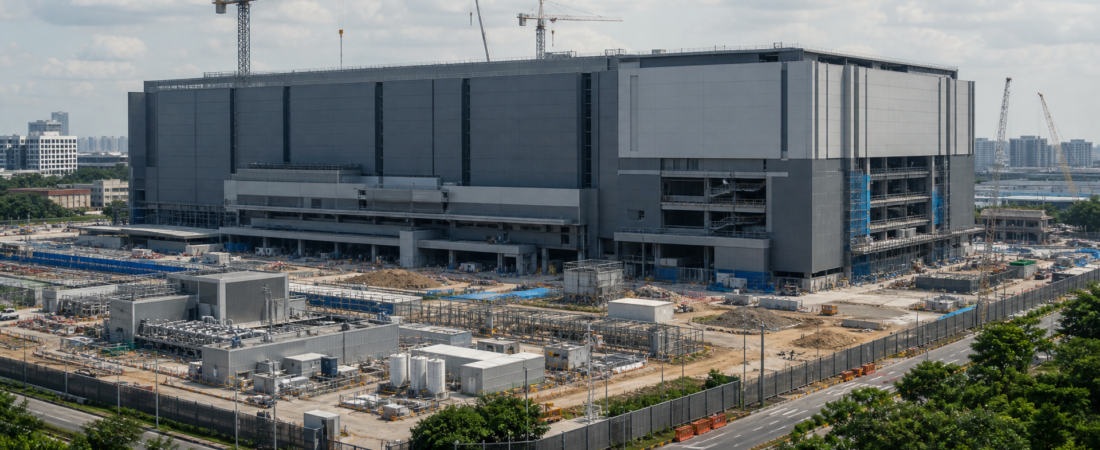
Vanguard International Semiconductor is accelerating capital spending and capacity expansion, with planned expenditure of NT$60 billion to NT$70 billion primarily directed toward a new 12-inch fab in Singapore, according to the available source information. The reported driver is structural demand for AI power management chips.
That matters because it shifts attention to a less visible part of the AI hardware stack. While most AI semiconductor coverage focuses on leading-edge compute chips, large-scale AI deployment also depends on mature-node components that manage power delivery and efficiency. Those chips do not carry the same profile as AI accelerators, but they are essential to keeping servers, racks, and data-center systems running.
For Asia’s semiconductor landscape, the reported expansion points to two broader themes. First, AI demand may be extending deeper into the mature-node foundry market, not just the leading edge. Second, Singapore continues to feature in regional semiconductor capacity planning, reinforcing Southeast Asia’s role in supply-chain diversification around Taiwan-centered production networks.
The available source information does not establish how broad this demand shift will become across the industry. But VIS’s move suggests that at least one established foundry sees AI-related power management demand as durable enough to justify a larger manufacturing footprint.
Watch the Short Brief
Watch this short visual briefing for the key strategic implications behind the story.
Key Developments
According to the reported information, Vanguard International Semiconductor is increasing capital expenditure to between NT$60 billion and NT$70 billion.
The spending is expected to be focused mainly on the company’s new 12-inch fab in Singapore.
The stated rationale is to address structural demand for AI power management chips. That framing is important. It suggests the company views the demand as more than a short-term order spike or a conventional semiconductor cycle rebound.
The confirmed geographic relevance in this development is clear: a Taiwan-linked semiconductor company is directing major investment toward Singapore, adding to a regional production story that spans both Northeast Asia and Southeast Asia.
Beyond those points, the available source information is limited. It does not provide detailed output targets for the fab, named customers, production timing, or a fuller breakdown of end markets. It also does not establish whether this move is part of a wider coordinated shift among peers, or primarily a company-specific response to its own order outlook.
Strategic Analysis
The most important implication of this development is that AI infrastructure demand may be pulling on supply chains far beyond advanced GPUs and cutting-edge logic. Power management chips are a quieter but necessary layer of AI deployment. As compute density rises, systems need tighter power regulation, conversion, and distribution. That creates a logical pathway for demand growth in components that are typically produced on mature process nodes rather than frontier nodes.
In that sense, VIS’s reported expansion could be read as a signal that AI is starting to influence capacity planning in parts of the semiconductor market that have often received less strategic attention. Mature-node foundries are usually discussed through the lens of industrial, automotive, consumer, and general analog demand. If AI-related infrastructure now becomes a sustained driver for power management chips, that may gradually alter how capacity is valued in this segment.
That does not mean mature-node foundries suddenly become direct proxies for AI compute demand. The connection is more indirect and should be handled carefully. Demand for power management chips depends on broader system buildouts, customer design cycles, and infrastructure spending patterns, not only on shipments of AI accelerators. Even so, the reported rationale behind VIS’s spending suggests that AI is broadening its impact across the semiconductor value chain.
This is strategically relevant for Asia because the region already dominates much of the world’s semiconductor manufacturing base, but different geographies within Asia play different roles. Taiwan remains central to foundry production and semiconductor ecosystem depth. Singapore, by contrast, has positioned itself as a stable and internationally connected manufacturing location with an established semiconductor presence. A Taiwan-linked investment into a 12-inch fab there fits a wider regional logic: supply chains are not leaving Asia, but they are becoming more distributed within Asia.
That distinction matters. Supply-chain diversification is often described too simplistically as a move away from concentration risk. In practice, many companies are diversifying through an Asia-plus-Asia model, where production capacity is spread across multiple Asian jurisdictions rather than shifted out of the region altogether. The VIS expansion appears consistent with that pattern, even if the available source information does not specify the exact motivations behind the Singapore site.
Another implication is capital discipline. Semiconductor capacity expansions are long-cycle commitments. A company does not allocate NT$60 billion to NT$70 billion lightly, especially in a segment not usually associated with the most visible AI upside. If the reported spending level is sustained, it suggests management sees enough persistence in the demand outlook to commit to new wafer capacity rather than rely only on incremental efficiency gains or short-term utilization improvements.
That may also have second-order effects on competitive positioning. If AI-related power management demand grows faster than expected, foundries with the right process mix and execution capability could gain bargaining leverage in selected niches of the mature-node market. That is not the same as saying broad-based pricing power has returned across the segment. The evidence provided here does not support such a sweeping conclusion. But it does support a narrower analytical point: AI demand could make some mature-node capacity categories more strategically valuable than they have appeared in conventional semiconductor market narratives.
The risk, of course, is that the market reads too much into a single expansion plan. One company’s capex decision is not enough to prove a structural reset across the sector. AI infrastructure demand can be uneven, and end-demand assumptions can change. Data-center investment cycles, customer inventory adjustments, and power architecture design shifts could all affect how durable the opportunity becomes for suppliers of power management chips.
Still, the broader analytical takeaway remains useful. The AI buildout is not just a story about advanced computing silicon. It is also a story about all the supporting semiconductors required to make high-power systems practical at scale. If that supporting layer tightens, bottlenecks can emerge in places the market has not fully priced into its semiconductor narratives.
Investor Takeaway
The reported VIS expansion is best understood as an early signal of AI’s widening effect on semiconductor capacity decisions in Asia, particularly in mature-node categories tied to power infrastructure.
For investors and industry observers, the first issue to watch is execution. The central reported fact is the planned NT$60 billion to NT$70 billion capex range, mainly for the Singapore 12-inch fab. The key question is whether that investment proceeds on the expected timeline and translates into commercially meaningful output for AI-related applications.
The second issue is demand confirmation. If AI power management demand is truly structural, similar commentary may begin to appear elsewhere in the supply chain, including among analog, power, and mature-node manufacturing players. One company’s view is notable; a broader pattern would be more significant.
Third, investors should monitor whether AI infrastructure demand increasingly creates pressure in less celebrated semiconductor categories. If power-related components become a practical constraint on server deployment or data-center scaling, the market may need to rethink where value accrues in the AI hardware stack.
Fourth, the geographic dimension deserves attention. A Taiwan-linked manufacturer committing major spending to Singapore reinforces the importance of intra-Asia diversification rather than simple deglobalization narratives. That has implications for supply-chain resilience, regional policy competition, and the future map of semiconductor manufacturing in Asia.
The prudent conclusion is not that mature-node foundries have entered a new era overnight. It is that AI may be broadening the definition of strategic semiconductor capacity. VIS’s reported move into larger Singapore-based investment could become a useful indicator of that shift if follow-through from the company and the wider industry confirms the trend.