Executive Summary
According to the available source information, US battery manufacturers are accelerating plans around sodium-ion technology by using production lines that can also support lithium-ion manufacturing. The reported approach is aimed at lowering the cost of entry for sodium-ion output while reducing exposure to lithium supply chains that remain geographically concentrated.
That combination matters because it links chemistry choice directly to capital allocation. Rather than building fully separate sodium-ion factories, manufacturers appear to be adapting existing lithium-ion infrastructure to pursue a lower-cost path into an alternative battery chemistry. If the reported strategy scales beyond early deployment, it could become an important template for how battery companies manage both funding pressure and upstream materials risk.
For TechPowerAsia readers, the development is relevant not only as a US battery story but also as a signal for the broader Asia technology landscape. China remains central to the battery value chain, so any credible effort by US manufacturers to reduce dependence on lithium-linked inputs or processing routes has implications for supply-chain positioning, industrial competition, and future capital flows across energy storage.
Watch the Short Brief
Watch this short visual briefing for the key strategic implications behind the story.
Key Developments
According to the report, US battery manufacturers are moving faster on sodium-ion battery plans rather than treating the chemistry as a distant or purely experimental option.
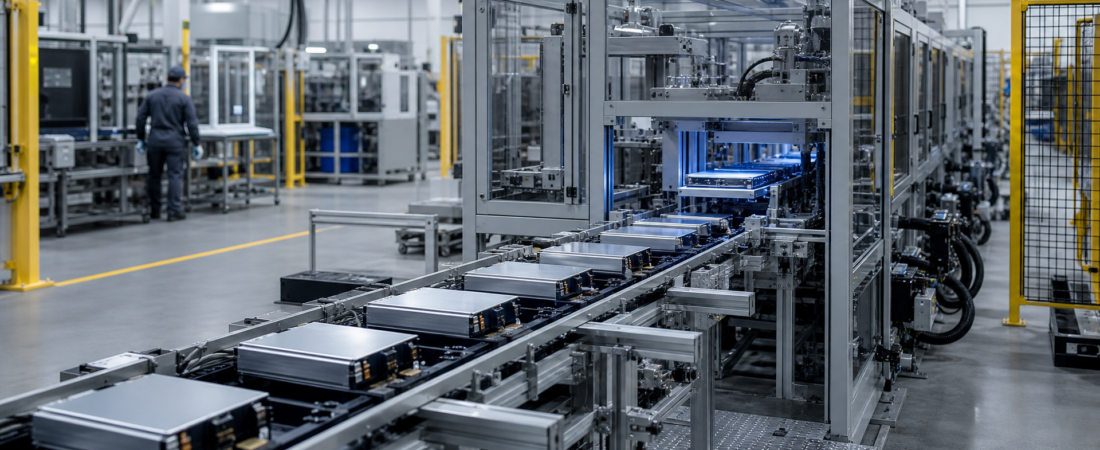
A key operational detail is the use of shared production lines with lithium-ion manufacturing. Based on the available information, companies are not necessarily building dedicated sodium-ion facilities from scratch. Instead, they are using a dual-chemistry manufacturing approach that could lower upfront capital needs and make the transition easier to finance.
The source summary also indicates that this shared-line model is helping attract investment. The logic appears straightforward: if sodium-ion output can be added through existing or adaptable lithium-ion infrastructure, the cost and execution risk may look more manageable to capital providers than a greenfield buildout.
A second stated motivation is supply-chain exposure. The available source information says US manufacturers are pursuing sodium-ion in part to reduce reliance on lithium supply chains that are geographically concentrated. In strategic terms, this suggests that battery makers are evaluating not just where inputs come from, but whether they can reduce dependence on a specific input set in the first place.
What the report does not provide is equally important. No company names were included in the available source packet. No investment amounts, production volumes, facility locations, or commercialization timelines were disclosed in the material provided here. That leaves the strategic signal intact, but it limits any firm conclusion on scale, pace, or competitive leadership.
The regional framing remains important. The development centers on the United States, but its significance extends to China because battery manufacturing competitiveness is shaped by chemistry choices, materials access, and processing ecosystems. Even without detailed company disclosure, the reported shift points to a supply-chain conversation that is inherently cross-border.
Strategic Analysis
The most important aspect of this development is not that sodium-ion is suddenly replacing lithium-ion. The stronger interpretation, based on the available information, is that some US battery makers are trying to create optionality. In other words, chemistry diversification may be emerging as a practical risk-management strategy rather than just a research agenda.
That distinction matters. Much of the battery industry’s resilience debate has focused on sourcing, refining, and localization within the existing lithium-ion framework. The reported sodium-ion push suggests a different line of thinking: part of the answer to supply-chain concentration may be to broaden the chemistry base, not simply to replicate lithium-ion capacity in new geographies.
If that logic holds, shared manufacturing lines become strategically significant. A battery producer that can run or adapt lines across multiple chemistries may gain flexibility that extends beyond cost savings. It may be able to test market demand more quickly, match chemistry to application, and reduce the financial risk of backing a single technology path too early. In today’s funding environment, that flexibility itself can be an asset.
For Asia-focused technology intelligence, this is where the report becomes more than a niche battery update. China’s strength across major parts of the battery ecosystem has made chemistry decisions inseparable from geopolitics and industrial strategy. The source material does not quantify that advantage, and the article should not overstate it. But one clear implication is that US manufacturers are looking for ways to reduce vulnerability to bottlenecks that may sit outside their control.
That does not mean sodium-ion is automatically a full substitute for lithium-ion. The available source information does not include technical performance data, cost comparisons, application details, or target end markets. As a result, the safest interpretation is that sodium-ion is being positioned as a complement or hedge, at least for now, rather than as an outright replacement across the battery landscape.
This point is especially important for investors and strategic planners. Alternative chemistries often generate attention long before they generate durable commercial share. What gives this development more weight than a typical laboratory narrative is the manufacturing element. The report is not centered on a theoretical chemistry breakthrough. It is centered on production strategy and capital efficiency. That makes it more relevant to execution than many early-stage battery stories.
Still, caution is necessary. A shared-line model may lower barriers, but it does not by itself prove commercial viability. The key unanswered questions include throughput, yields, qualification timelines, customer acceptance, and whether these production lines can support meaningful volume without undermining lithium-ion operations. None of that is confirmed in the available source packet.
Another strategic question is whether this becomes a narrow US workaround or part of a broader industry pattern. If manufacturers can use flexible lines to add sodium-ion without taking on heavy greenfield risk, the model could attract broader interest in energy storage segments where lithium dependence is viewed as a strategic weakness. But that remains a scenario, not a confirmed trend, based on the evidence provided here.
The reported development also highlights how capital markets are increasingly shaping technology direction in battery manufacturing. Companies do not just need a credible chemistry roadmap; they need a financeable one. Shared lines may help bridge that gap by turning sodium-ion from a speculative side project into a more investable manufacturing extension. If confirmed at scale, that would be one of the more practical lessons from this shift.
Investor Takeaway
The reported acceleration in sodium-ion plans should be treated as an early but strategically relevant signal. According to the available source information, US battery manufacturers are pursuing a lower-capex route into sodium-ion by using shared lithium-ion production lines, with the twin goals of attracting investment and reducing exposure to concentrated lithium supply chains.
For investors, the immediate takeaway is not that sodium-ion has reached broad commercial inflection. The evidence provided here is not strong enough for that conclusion. Instead, the more useful reading is that battery makers may be experimenting with a more flexible manufacturing model that could improve financing prospects while giving them a hedge against materials concentration risk.
Several indicators now matter more than the headline itself.
First, investors should monitor company identification. Once specific manufacturers are disclosed, it will be easier to judge whether this is being led by venture-backed specialists, established battery producers, or a mix of both.
Second, capital formation will be a critical test. The source summary says shared lines are drawing investment, but the absence of funding figures means the scale of market conviction is still unclear. Any future disclosure on fundraising, project finance, or strategic capital partnerships would help determine whether this is a meaningful industrial shift or a limited pilot phase.
Third, execution evidence matters more than concept validation. Investors should watch for details on production ramp, customer qualification, manufacturing yields, and end-use positioning. Without those markers, sodium-ion remains strategically interesting but commercially unproven.
Fourth, the Asia angle should stay central. Battery competition is shaped by regional ecosystems, not isolated factory decisions. If US manufacturers gain credible optionality through shared lines, the implications may extend into supply-chain bargaining power, future procurement strategies, and how capital is allocated across battery chemistries in both the US and Asia.
In short, this report points to a potentially important shift in battery strategy: reducing exposure to upstream risk not only through supplier diversification, but through chemistry diversification tied to more capital-efficient manufacturing. That is a development worth tracking closely, even if the current evidence supports caution more than certainty.