Executive Summary
According to the available source information, Anthropic has committed $45 billion over six years to secure AI compute capacity from UK-based infrastructure provider Nscale at a campus in West Virginia. The reported arrangement covers 460 megawatts of capacity and includes on-site power generation intended to bypass grid interconnection bottlenecks. The source also indicates that the deployment is tied to Nvidia’s next-generation Vera Rubin systems.
If accurate, the deal is notable less as a conventional cloud contract than as a large industrial-style capacity agreement built around three scarce inputs at once: accelerators, power, and time. That matters for TechPowerAsia readers because the underlying constraints are global. Even though the reported transaction sits in the US and UK, it points to the same forces shaping Asia’s technology landscape: dependence on Nvidia-centered semiconductor supply chains, the rising strategic value of power-secure data center capacity, and the need for large, long-duration capital commitments to support frontier AI development.
One implication is that AI infrastructure competition may be moving beyond access to chips alone. Securing deployable power and dedicated compute at scale could become just as important as negotiating accelerator supply. For Asia, that raises strategic questions around where future AI campuses are built, which parts of the semiconductor stack capture value, and how capital flows toward power-linked digital infrastructure.
Watch the Short Brief
Watch this short visual briefing for the key strategic implications behind the story.
Key Developments
According to the source summary, Anthropic has entered into a six-year agreement valued at $45 billion with Nscale, a UK-based cloud and compute infrastructure company.
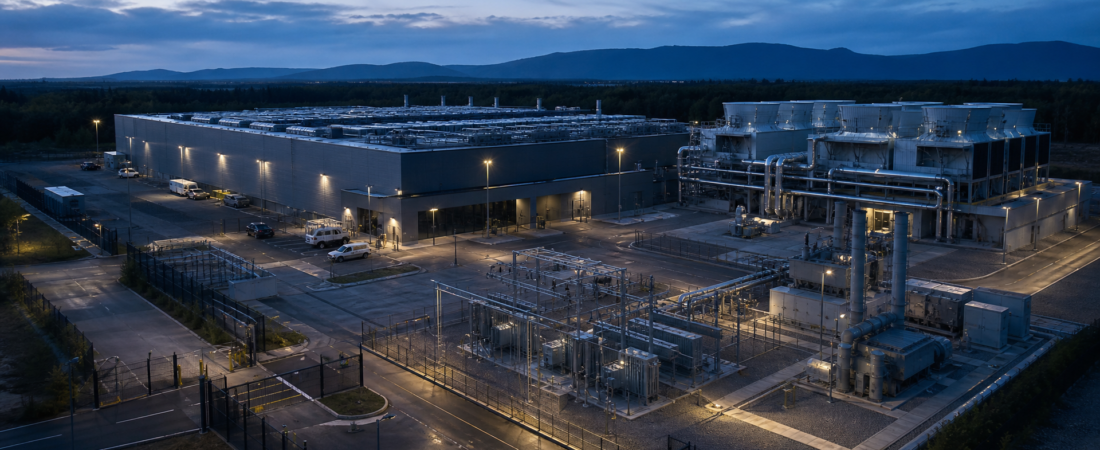
The reported deal secures 460 megawatts of AI compute capacity at a data center campus in West Virginia, in the United States.
The facility is described as having on-site power generation designed to avoid delays associated with conventional grid bottlenecks.
The source information also indicates that the arrangement is tied to Nvidia’s Vera Rubin systems, which are expected to represent Nvidia’s next-generation AI computing platform.
Based on the available information, the directly relevant companies are Anthropic, Nscale, Nvidia, and Microsoft, although the source summary provided here does not establish any confirmed operational role for Microsoft in the specific capacity allocation and no broader claim is necessary to understand the significance of the transaction.
The reported geographic footprint is also clear: the infrastructure project is located in the United States, while Nscale is based in the United Kingdom. The immediate Asia relevance is therefore indirect, but the strategic implications extend into semiconductor supply chains, data center buildout models, and capital allocation patterns that are highly relevant across Asia.
Strategic Analysis
This reported agreement may indicate that frontier AI developers are increasingly treating compute access as a strategic asset that must be secured years in advance. In earlier phases of the AI market, the dominant assumption was that cloud capacity could be expanded through standard service agreements. A multiyear commitment of this scale suggests something different: leading model developers may now need dedicated infrastructure rather than flexible on-demand access, particularly when the most advanced systems are supply constrained.
A second implication is that power availability is becoming inseparable from AI infrastructure planning. The reported use of on-site generation to bypass grid constraints is strategically important because it shifts the bottleneck from data center leasing to integrated energy-and-compute development. That may matter as much as chip access. In practical terms, a company with accelerator supply but no power-secure site may still struggle to scale. Conversely, a campus that can combine land, energy, cooling, and deployment-ready hardware may command a growing premium.
For Asia, this is a meaningful signal. Several Asian markets are trying to expand AI data center capacity while balancing energy security, permitting complexity, and industrial policy goals. If the West Virginia model proves viable, policymakers and infrastructure developers across Asia may study whether similar approaches can work locally. That does not mean replication will be easy. Power market structures, fuel availability, regulation, and land constraints differ widely across Japan, South Korea, India, Southeast Asia, and the Gulf-linked investment corridors that increasingly intersect with Asian capital flows. Still, the reported deal reinforces a core lesson: AI infrastructure is becoming an electricity strategy as much as a semiconductor strategy.
The Nvidia angle also deserves attention. The reported use of Vera Rubin systems suggests that customers may be making long-duration commitments around Nvidia’s roadmap before broad deployment is visible. If that pattern holds, the value chain implications are significant. Nvidia’s AI platforms sit atop a wider manufacturing ecosystem that depends on advanced packaging, high-bandwidth memory, networking, and precision manufacturing capabilities in which Asian companies play a major role. Even without naming specific suppliers in this case, the broader linkage is straightforward: large AI capacity reservations can translate into pressure throughout the hardware stack, especially for components and processes that already operate under tight timelines.
That creates a second-order strategic consequence for Asia’s semiconductor industry. The more AI infrastructure deals are structured years ahead of deployment, the more upstream suppliers may need to plan capacity with longer visibility but also greater concentration risk. Long-dated commitments can improve forecasting, yet they can also magnify execution risk if demand assumptions change, delivery schedules slip, or next-generation platforms face integration delays.
Another important feature of the reported transaction is its financing logic. A $45 billion commitment over six years points to a model in which compute is being financed through long-term contractual obligations rather than short-cycle consumption. This could reshape how investors think about AI infrastructure assets. Rather than viewing data centers only as real estate plus tenants, the market may increasingly analyze them as specialized industrial platforms whose economics depend on power reliability, hardware procurement, and counterparty durability.
That shift has implications for capital flows into and out of Asia. Sovereign capital, infrastructure funds, private credit, and strategic industrial investors across the region are already active in semiconductors, digital infrastructure, and energy transition themes. If AI campuses increasingly require integrated financing for chips, facilities, and power, Asia-based capital pools may find more opportunities in infrastructure partnerships, component supply expansion, and energy-linked digital buildouts. At the same time, such projects are likely to require stronger diligence because the technical and commercial dependencies are unusually concentrated.
It is also worth keeping the limits of the current evidence in mind. The available source information supports the broad outline of a major Anthropic-Nscale deal tied to 460 megawatts, on-site power, and Vera Rubin systems. It does not provide deeper detail on financing structure, construction sequencing, or the exact technical configuration of the deployment. That means the strategic reading should remain cautious. Even so, the core pattern is clear enough to matter: AI infrastructure competition is becoming more capital intensive, more energy constrained, and more tightly coupled to the semiconductor roadmap.
Investor Takeaway
The main takeaway is not simply that Anthropic is spending heavily. It is that the reported structure of the commitment may reflect a broader shift in how frontier AI capacity is procured and financed. Investors should watch whether similar agreements emerge elsewhere, especially those that bundle accelerator access with dedicated power solutions and multiyear capacity reservations.
For semiconductor-focused readers, the most relevant signal is continued concentration around Nvidia-led AI platforms and the upstream manufacturing ecosystems that support them. Asian exposure is likely to be strongest not through this specific site, but through the supply chains behind advanced AI systems, including packaging, memory, interconnect, and related manufacturing services.
For digital infrastructure and energy investors, the reported use of on-site generation is especially important. If AI campuses increasingly need to solve their own power constraints, value may shift toward developers and financiers that can integrate electricity, land, cooling, and compute deployment rather than offering generic colocation capacity.
For capital allocators, the key question is whether long-duration AI compute agreements become common enough to support a new class of infrastructure financing. If they do, Asia could become an important source of both equipment and capital. If they do not, the market may remain vulnerable to overbuild concerns, concentrated counterparty exposure, and project-level execution risk.
In short, according to the available source information, the Anthropic-Nscale agreement is a significant data point in the evolution of AI infrastructure. Its direct footprint is transatlantic, but its strategic meaning is global: in the AI era, chips, power, and capital are increasingly being locked together in a single competitive equation.