Executive Summary
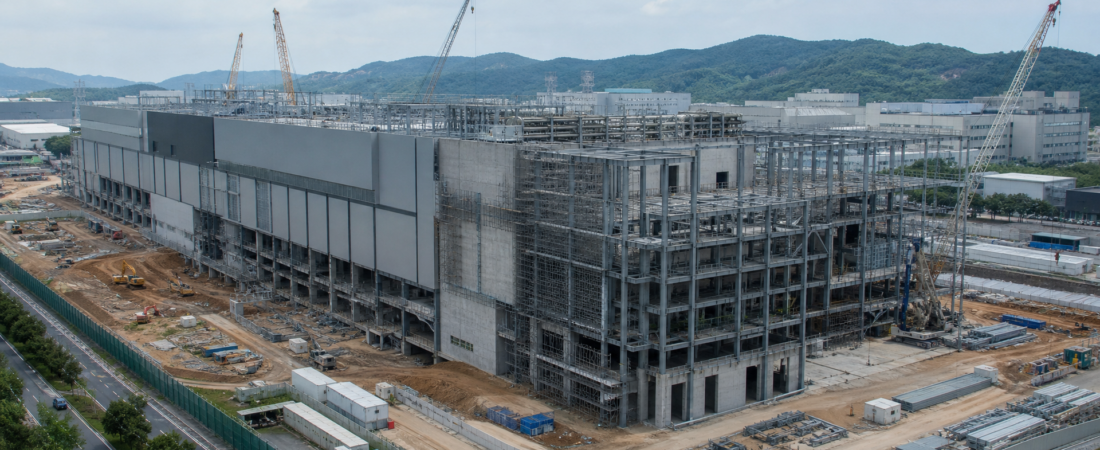
According to the available source information, TSMC is building 25 fabrication and packaging facilities globally in 2026, including 13 in Taiwan. The report also says this represents a fivefold increase from the company’s historical construction pace. Even at that scale, TSMC reportedly remains unable to keep up with AI-driven demand because of severe construction labor shortages.
That combination matters beyond one company’s expansion program. In the current AI cycle, investors and policymakers often focus on chip design leadership, manufacturing technology, or capital expenditure. This report suggests another constraint may be becoming more visible: the physical ability to build semiconductor capacity fast enough. If accurate, the issue is not simply whether money is available, but whether enough labor, project execution capacity, and site readiness exist to convert investment into working output.
For Asia, the report is especially significant because Taiwan still accounts for the majority of the cited projects. That reinforces the island’s central role in the global semiconductor system, even as TSMC expands into the United States and Germany. It also suggests that the speed of AI infrastructure growth may depend increasingly on construction realities in a handful of manufacturing hubs, not only on demand for chips.
Watch the Short Brief
Watch this short visual briefing for the key strategic implications behind the story.
Key Developments
– According to the report, TSMC is building 25 fabrication and packaging facilities worldwide in 2026.
– Of those, 13 are in Taiwan, underlining the island’s continued importance in the company’s manufacturing footprint.
– The available source information says this construction pace is roughly five times TSMC’s historical norm.
– Despite that expansion, the report says TSMC still cannot keep up with demand tied to the AI boom.
– The immediate constraint highlighted by the report is severe construction labor shortages.
– The source information links the expansion to projects across Taiwan, the United States, and Germany, indicating that the buildout challenge is not limited to one market.
Taken together, these points make the story less about a single demand spike and more about industrial execution. Semiconductor capacity is often discussed in terms of fabs, process nodes, and equipment. This report shifts attention toward a more basic question: how quickly can these facilities actually be built and brought into operation when many projects are underway at once?
Strategic Analysis
The most important implication is that AI-era semiconductor expansion may be constrained by physical throughput as much as by financial commitment. TSMC’s reported buildout is unusually large by any recent standard. If a fivefold increase in construction activity still falls short of AI demand, then headline investment plans alone may not be a reliable guide to near-term supply growth.
This matters because semiconductor manufacturing capacity is not created the moment a company announces a project. Fabs and packaging plants require land preparation, civil works, cleanroom construction, utilities, specialized installation, and commissioning. Those steps depend on large ecosystems of contractors, trades, engineers, and project managers. In other words, semiconductor scale-up is not just a capital markets story. It is also a labor and execution story.
The inclusion of packaging facilities in the reported total is also important. In the AI supply chain, packaging capacity can be nearly as critical as wafer fabrication because advanced AI chips depend on increasingly complex assembly and integration steps. The source does not provide technical detail on which packaging lines are involved, so it would be premature to draw narrow conclusions. Still, the broader point stands: wafer capacity and downstream packaging capacity need to expand together, and both can be affected by construction bottlenecks.
For Asia, Taiwan remains the central point of gravity. With 13 of the 25 reported facilities located there, the island continues to anchor TSMC’s expansion even as projects proceed in the United States and Germany. That has two strategic implications. First, Taiwan’s domestic construction environment remains highly relevant to the pace of global AI hardware supply. Second, geographic diversification does not remove dependence on Taiwan if the majority of incremental buildout is still concentrated there.
At the same time, a multi-region construction push may create new complexities rather than automatically easing old ones. Taiwan, the United States, and Germany each have different labor pools, permitting systems, cost structures, and construction practices. The report does not specify whether shortages are most severe in one location or across all of them. Even so, the simultaneous spread of projects across several regions suggests that labor availability itself may become a competitive variable in semiconductor strategy.
This is where the report carries broader significance for AI infrastructure expectations. Much of the market narrative around AI assumes that supply will eventually catch up as large manufacturers keep adding capacity. That may still happen, but this report suggests the pace could be less elastic than many assume. If construction labor becomes a persistent bottleneck, capacity expansion may proceed more slowly than announced spending levels imply.
That does not prove specific downstream outcomes such as longer lead times, customer allocation changes, or margin effects. The source material does not establish those results. However, it does raise the possibility that AI-related semiconductor tightness could last longer if the industry’s limiting factor has moved from equipment orders or funding decisions to site execution and workforce availability.
The geopolitical angle also deserves attention, though it should be framed carefully. The reported presence of projects in Taiwan, the United States, and Germany shows that semiconductor capacity expansion is now being attempted across several strategic jurisdictions at once. If construction bottlenecks intensify in multiple regions, governments may find that industrial policy support and announced incentives are only part of the equation. Workforce depth, local contractor capacity, and infrastructure readiness may matter just as much in determining how quickly new manufacturing can come online.
Investor Takeaway
The immediate lesson is that semiconductor capacity announcements should be read with an execution lens, not only a spending lens. According to the available source information, TSMC is already building at an unusually aggressive pace. Yet the company reportedly still cannot keep up with AI demand because of labor shortages tied to construction. That suggests investors should pay closer attention to how fast facilities can actually be completed, not just how many are announced.
Several monitoring points follow.
First, watch whether TSMC provides additional disclosure on construction timelines, labor availability, or the pace at which these facilities are expected to enter service. Any commentary that clarifies whether shortages are easing, persisting, or spreading would matter more than headline project counts alone.
Second, monitor Taiwan’s role in the expansion. With more than half of the reported projects located there, Taiwan remains central to global semiconductor capacity growth. If local labor or infrastructure constraints emerge as recurring issues, the effects could extend well beyond the domestic market.
Third, track whether similar execution issues appear in the United States and Germany. If multiple regions face parallel labor constraints, geographic diversification may improve resilience over time but still fail to accelerate near-term capacity as quickly as expected.
Fourth, consider the implications for the broader AI supply chain. Companies planning around future compute availability may need to watch the buildout cycle more closely. If construction becomes the binding constraint, the conversion of semiconductor capital expenditure into usable AI infrastructure could take longer than market narratives assume.
The broader strategic point is clear even if some second-order effects remain uncertain: in the AI era, the semiconductor bottleneck may increasingly sit at the intersection of construction capacity, labor availability, and manufacturing geography. For Asia, and especially for Taiwan, that makes industrial execution itself a core part of technology intelligence.