Executive Summary
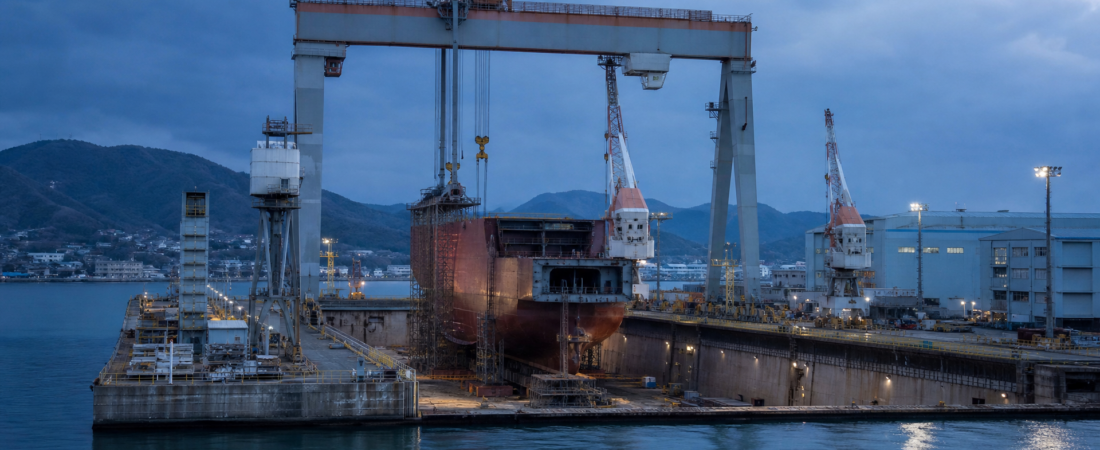
According to the reported information, Japan has approved its first shipbuilding revival projects, committing ¥213.1 billion, or about $1.36 billion, to three domestic shipyard groups. The stated aim is to rebuild the country’s maritime manufacturing capacity through yard revival and modernization.
On the surface, this is a sector-specific funding decision. Strategically, it looks more important than that. In Asia, governments are increasingly willing to use targeted capital support to restore production capacity in industries viewed as nationally significant, especially where long investment cycles and weaker private-sector economics have limited reinvestment.
For TechPowerAsia readers, the signal is less about a single funding round and more about policy direction. Japan appears willing to intervene directly in heavy industrial capacity, not only in frontier technology sectors such as semiconductors, but also in foundational manufacturing systems that underpin logistics, industrial supply chains, and broader economic resilience.
The available source information does not identify the three recipient yard groups, nor does it detail funding structure, milestones, locations, or end-market focus. That means the announcement should be read first as a policy signal, with the real strategic weight depending on implementation.
Watch the Short Brief
Watch this short visual briefing for the key strategic implications behind the story.
Key Developments
Japan has approved what the report describes as its first shipbuilding revival projects. The total commitment is ¥213.1 billion, equivalent to roughly $1.36 billion based on the reported figures.
The funding is set to go to three domestic shipyard groups. The available information does not name those recipients, and no breakdown of allocations has been disclosed in the source material provided here.
The central stated objective is to rebuild Japan’s maritime manufacturing capacity. According to the source summary, that includes capacity expansion and modernization of shipyard infrastructure.
This matters because it suggests a move beyond rhetorical industrial policy and into direct capital deployment. Even without full program detail, the approval of specific projects indicates that Tokyo is backing concrete industrial assets rather than limiting its response to planning frameworks or high-level policy statements.
At the same time, much remains unknown. The available source information does not specify whether the support will take the form of grants, loans, or other instruments. It also does not set out project timelines, output targets, labor plans, or technology requirements. Nor does it clarify whether this is the first step in a larger multi-round program or a more limited intervention.
Those missing details are important, because in capital-intensive industries the difference between a symbolic funding package and a meaningful restructuring program usually lies in execution design: how funds are released, what capabilities are prioritized, and whether follow-on support is available.
Strategic Analysis
Japan’s move fits a broader Asian pattern: governments are becoming more explicit about rebuilding strategic production capacity in sectors where market forces alone may not deliver the desired level of domestic capability. In recent years, this logic has been most visible in semiconductors, batteries, and other advanced manufacturing areas. The reported shipyard funding suggests the same policy instinct is extending into heavy industry.
That matters because shipbuilding is not just another manufacturing line. It sits inside a wider industrial system that includes steel, machinery, marine equipment, engineering labor, port infrastructure, and long-duration capital planning. Once such ecosystems thin out, rebuilding them is expensive and slow. A government willing to provide more than ¥200 billion in initial support may be signaling that it sees the underlying industrial base as worth preserving or restoring despite those frictions.
For Japan, this could reflect a broader reassessment of resilience. Over the past several years, industrial policy across Asia has increasingly been shaped by questions of dependency, production concentration, and control over strategically important supply chains. In that context, maritime manufacturing capacity can be viewed as part of a wider national capability stack, alongside energy systems, advanced materials, and semiconductor infrastructure.
The policy logic is straightforward even if the operational details remain unclear. Domestic capacity in heavy industry can matter well beyond direct profit-and-loss calculations. It may support industrial employment, supplier continuity, technical know-how, and the ability to respond to future bottlenecks. Those considerations have become more prominent as governments across the region reconsider how much strategic manufacturing they are comfortable outsourcing.
This is also an Asia-relevant signal because it broadens the map of state-backed competition. Much of the discussion around industrial policy has focused on chips and AI infrastructure. Japan’s shipyard decision suggests that the same toolkit of subsidies, targeted capital support, and capacity rebuilding is relevant in older but still strategically important sectors. Investors tracking regional policy should not assume that state intervention will remain confined to digital technologies.
Even so, the announcement should be interpreted with discipline. Capital commitments do not automatically restore competitiveness. Shipyard revival depends on far more than budget authorization. It requires project execution, labor availability, supplier coordination, yard productivity, and sustained order visibility. If any of those elements are weak, a headline funding number can overstate real industrial impact.
There is also the question of time horizon. Rebuilding or modernizing shipyard capacity is a multi-year process. New equipment, site upgrades, workforce development, and production ramp-up all take time. That means this announcement is unlikely to produce immediate measurable changes in output or market position. Its first-order importance is strategic intent; its second-order importance will depend on whether Japan can translate that intent into durable operating capability.
Another implication is that industrial policy in Asia is becoming more layered. Rather than treating advanced technology and traditional manufacturing as separate tracks, governments are increasingly linking them under a broader resilience agenda. Shipbuilding may not sit at the center of AI-era policy narratives, but it does intersect with digital design tools, industrial automation, materials supply, and trade infrastructure. In that sense, Japan’s move is consistent with a wider regional shift toward rebuilding industrial depth, not just pursuing frontier innovation.
For TechPowerAsia, that is the more important takeaway. The significance of this announcement is not limited to ships. It reflects a governance model in which states are more willing to shape capital allocation when they believe an industrial capability has strategic value and cannot be left entirely to market consolidation.
Investor Takeaway
This is best viewed as an early policy signal rather than a finished investment thesis. The reported ¥213.1 billion commitment is meaningful, but the investable implications will depend on details that have not yet been disclosed publicly in the source material provided here.
The first thing to watch is recipient clarity. Once the three yard groups are identified, investors will be in a better position to assess whether the program is supporting scale leaders, distressed assets, regional specialists, or a mix of the three. That distinction will shape expectations around execution quality and downstream supply-chain benefits.
Second, investors should monitor program structure. Grants, concessional loans, tax incentives, and co-investment mechanisms create very different outcomes for balance sheets, capital discipline, and operating leverage. Without that information, the headline number is directionally important but analytically incomplete.
Third, the key question is whether the initiative expands into a broader industrial package. If this first round is followed by additional project approvals, supplier support, workforce measures, or demand-side policy tools, the announcement could mark the start of a more serious rebuilding cycle. If it remains a one-off measure, its long-term impact may be narrower.
Fourth, supply-chain spillovers deserve attention. A real shipyard revival effort could create opportunities for marine equipment makers, machinery providers, steel and materials suppliers, automation vendors, and industrial engineering firms. But those spillovers should be monitored through actual contract flow and capacity utilization, not assumed from the subsidy alone.
Finally, investors should place this development in a wider Asia policy context. Japan’s move may indicate that strategic manufacturing support is broadening beyond semiconductors and energy-transition sectors into other industrial domains considered important for resilience. That does not mean every legacy industry will see a similar revival push. It does suggest, however, that capital allocation in Asia is being shaped increasingly by strategic capability goals as well as near-term market returns.
In short, the announcement is significant as a marker of policy direction. The central reported fact is clear: Japan has approved its first shipbuilding revival projects and committed ¥213.1 billion to three domestic yard groups. The strategic question now is whether that initial commitment becomes the foundation of a sustained industrial rebuilding effort or remains a limited intervention with more symbolic than structural effect.