Executive Summary
South Korea has dispatched a military assessment team to the United Arab Emirates, according to the available source information, as Seoul weighs whether to provide some form of support to US-led efforts in the Strait of Hormuz. The reported move does not amount to a deployment decision. But it does indicate that Seoul is actively assessing its options at a moment when conflict involving Iran has raised the strategic stakes around one of the world’s most important energy transit corridors.
For Asia, the significance is broader than defense policy. The Strait of Hormuz remains a critical route for energy flows into import-dependent economies across the region. Any sustained disruption could affect industrial planning, power costs, shipping confidence, and supply-chain resilience. That matters especially for economies such as South Korea, where advanced manufacturing capacity, including semiconductor production, depends on stable and affordable energy inputs.
The immediate takeaway is caution rather than conclusion. According to the report, Seoul has taken a preparatory step, not a final one. Even so, the episode is a reminder that Asian technology and industrial systems remain exposed to geopolitical shocks that originate far outside the region.
Watch the Short Brief
Watch this short visual briefing for the key strategic implications behind the story.
Key Developments
South Korea’s confirmed action, based on the available source information, is the dispatch of a military assessment team to the UAE. The reported purpose is to evaluate possible support for US-led operations connected to security in the Strait of Hormuz.
That distinction matters. An assessment mission suggests Seoul is still in an information-gathering phase. No deployment decision, operational scope, timeline, or force commitment has been confirmed in the available material.
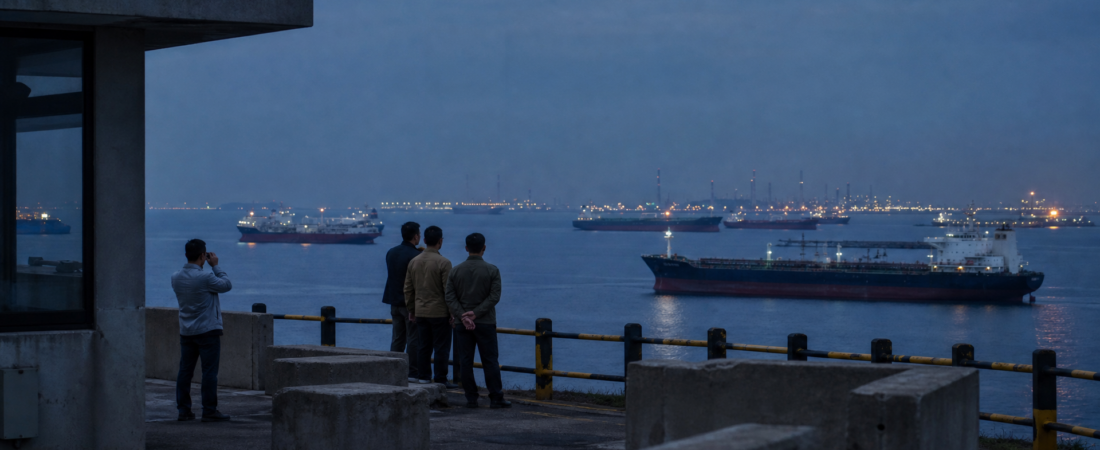
The broader backdrop, according to the source summary, is the war involving Iran and the resulting pressure on the Strait of Hormuz. The waterway is strategically significant because it is a major energy transit route for Asian economies, including countries whose industrial models rely on imported fuel.
This creates a difficult policy balance for Seoul. On one side is alliance coordination with the United States. On the other is the economic reality that any instability around Hormuz can affect the same energy flows South Korea depends on to sustain industrial activity.
No specific companies have been identified in direct connection with the development. The significance for business is therefore indirect at this stage: the story is about state security positioning, but the downstream risks could extend into industrial costs, logistics planning, and broader supply-chain resilience if regional instability deepens.
Strategic Analysis
The most important signal in this episode is not a military commitment, but the fact that Seoul appears to be preparing for a decision environment in which Middle East security and Asian industrial interests are directly linked.
A military assessment team is a cautious instrument. It allows policymakers to collect operational information, gauge political options, and preserve flexibility. In that sense, the reported move may indicate that Seoul wants to remain responsive to US security expectations without locking itself into a public commitment too early.
For TechPowerAsia readers, the larger strategic issue is exposure. South Korea is one of Asia’s most important advanced manufacturing economies. Its semiconductor and electronics sectors sit at the center of global technology supply chains, and those sectors depend on reliable power and stable industrial operating conditions. That does not mean a Hormuz-related shock would immediately translate into manufacturing disruption. It does mean that energy-route instability is not a peripheral issue for the region’s technology base.
This is an underappreciated feature of Asia’s industrial model. Much discussion of semiconductor resilience focuses on fabrication capacity, advanced packaging, equipment access, and trade controls. Those are critical variables. But energy security is also foundational. If a major maritime chokepoint comes under pressure, the first effects may show up in risk premiums, planning uncertainty, or procurement behavior before they appear in factory output.
That is why the South Korean move deserves attention even without a confirmed deployment. The reported assessment suggests Seoul is confronting two forms of interdependence at once: security dependence on the US alliance system, and economic dependence on uninterrupted Middle East energy flows. In periods of regional stability, those two relationships can coexist with limited friction. In a crisis, they can become harder to reconcile.
One implication is that Seoul may be trying to widen its decision room. By assessing conditions in the UAE rather than immediately announcing a commitment, the government can signal seriousness to Washington while retaining the ability to calibrate any eventual response. That calibration could matter domestically as well as strategically, especially if policymakers judge that visible military involvement could carry broader economic or diplomatic consequences.
A second implication is that Asian governments may increasingly have to treat maritime energy security as part of technology policy, not just foreign policy. Semiconductor competitiveness is often discussed in terms of subsidies, process leadership, and talent. Yet the ability to maintain predictable operating conditions also rests on less visible foundations, including shipping stability and fuel access. If Hormuz risk remains elevated, governments and companies may need to think more explicitly about the relationship between external security shocks and industrial continuity.
Potential second-order effects should still be framed cautiously. The available source information does not confirm changes in shipping insurance, freight behavior, or industrial input costs. But if tensions around Hormuz were to intensify, those are among the channels investors would likely watch. Risk perception alone can influence logistics planning and procurement decisions, particularly in sectors where margins, delivery schedules, or power requirements are tightly managed.
The same caution applies to regional alignment questions. South Korea’s reported assessment mission does not by itself establish a broader Asian trend. But it could become a reference point if other US-aligned economies begin similar reviews of their own exposure to Middle East security disruptions. Whether that happens will depend on the trajectory of the Iran conflict, the level of US coordination requests, and each country’s domestic political calculus.
In short, the development is best understood as an early warning signal rather than a confirmed policy shift. The strategic value lies in what it reveals about vulnerability. Asia’s high-value technology production remains linked to distant geopolitical chokepoints, and Seoul’s reported move brings that connection back into focus.
Investor Takeaway
Investors should treat this as a geopolitical-risk indicator, not a standalone industrial event.
The first question is whether the assessment mission leads to any formal South Korean deployment or security commitment. If Seoul moves beyond evaluation, that would mark a more meaningful policy step and could sharpen market attention on alliance-driven exposure to Middle East instability.
The second question is whether Hormuz-related risk begins to appear in measurable operating conditions. The available source information does not show that today. Still, investors with exposure to South Korean manufacturing, energy-intensive industry, or regional logistics should monitor whether shipping conditions, transit confidence, or energy-price volatility begin to deteriorate.
The third issue is sector sensitivity. Semiconductor and electronics manufacturing are not directly named in the source report, but they are part of the broader reason this matters for Asia technology intelligence. These sectors rely on predictable infrastructure and power availability. If a geopolitical shock begins to affect fuel access or industrial energy costs, even indirectly, manufacturing economics could come under pressure.
A fourth area to watch is policy signaling from other Asian economies. If comparable assessments or contingency planning efforts emerge elsewhere, the market may start to view Hormuz risk as a broader regional strategic variable rather than a narrowly South Korean one.
For now, the prudent reading is restrained. According to the reported information, South Korea has not committed to deployment. But the decision to send an assessment team suggests that the country is actively preparing for a scenario in which distant maritime security risks could have direct implications for Asian industrial resilience. For investors and strategic operators, that is reason enough to keep the story on the monitor.