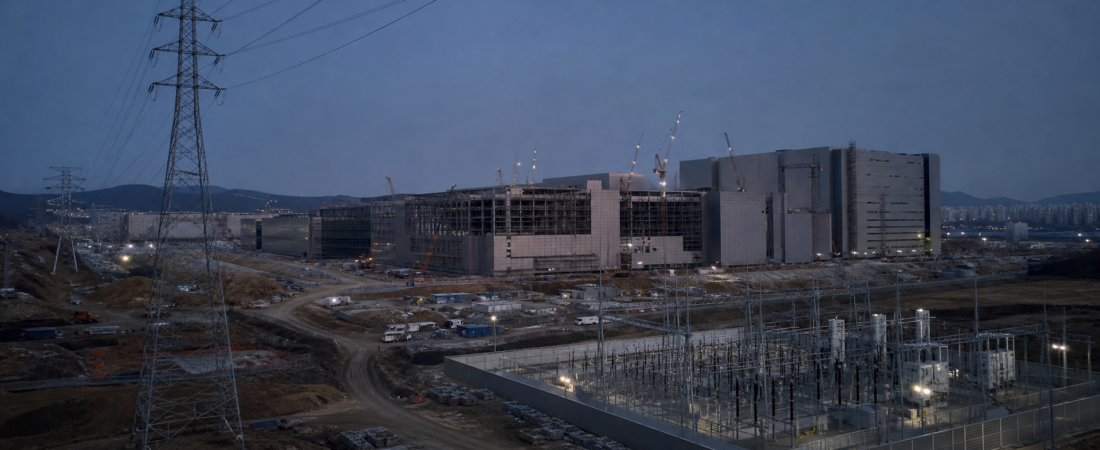
Executive Summary
According to the available source information, Samsung Electronics and SK Hynix have rejected a Korea Electric Power Corp. proposal to make a combined upfront payment of about $23.6 billion to fund power infrastructure for planned semiconductor mega clusters in South Korea. The reported reason was uncertainty over future semiconductor demand.
That makes this more than a financing disagreement. It highlights a core tension in semiconductor expansion: fabs require reliable power capacity years before production ramps, but companies are often being asked to commit capital before end-demand is clear enough to justify that scale of infrastructure spending.
For South Korea, the development matters because semiconductor competitiveness is not defined only by process technology or equipment access. It also depends on whether power, water, transport, and grid connectivity can be built on a schedule that matches industrial policy ambitions. If major chipmakers resist carrying more of that upfront infrastructure burden, the key issue becomes how the risk is ultimately allocated.
Watch the Short Brief
Watch this short visual briefing for the key strategic implications behind the story.
Key Developments
– According to the report, KEPCO proposed that Samsung Electronics and SK Hynix make a combined upfront payment of roughly $23.6 billion to support power-grid infrastructure tied to planned semiconductor mega clusters.
– The two chipmakers rejected the proposal, with the report indicating that demand uncertainty was a central reason.
– The dispute is tied to power infrastructure for planned large-scale semiconductor manufacturing sites in South Korea.
– The available source information does not provide further detail on the payment mechanism, repayment terms, timing, grid specifications, or whether an alternative arrangement is already under discussion.
– No confirmed delay to cluster construction, formal government response, or revised infrastructure plan was included in the available source information.
Strategic Analysis
At a strategic level, the reported rejection underscores a basic reality of semiconductor manufacturing: electricity is not a supporting detail. It is a foundational input, and large fab clusters require substantial and dependable power capacity well before production begins. In that sense, the issue is not only who pays for the grid upgrade, but who absorbs the risk of building ahead of demand.
That question is particularly important in semiconductors because capacity planning works on long lead times while demand conditions can change materially over a relatively short period. Memory markets, in particular, have historically been cyclical. Even when long-term technology demand appears constructive, companies still have to decide whether near-term visibility is strong enough to justify locking in very large infrastructure commitments.
Viewed through that lens, Samsung and SK Hynix’s reported rejection may reflect capital discipline as much as resistance to the proposal itself. An upfront payment of this size would effectively ask private manufacturers to pre-fund infrastructure that may only be fully utilized if future production plans and end-market demand develop as expected. For management teams, that is a different decision from investing directly in fabs, tools, or process migration. Infrastructure spending of this kind can be harder to stage, harder to redeploy, and more dependent on factors outside the companies’ direct control.
This also matters for how South Korea’s semiconductor strategy is executed. The country’s position in memory and broader chip manufacturing gives it strong industrial weight, but large-scale expansion depends on coordination across utilities, manufacturers, local development, and policy support. If any one part of that chain slows, the broader buildout can become more complicated even if the underlying industrial ambition remains unchanged.
It would be premature to conclude from one reported dispute that South Korea’s cluster plans are off track. The available information does not confirm construction delays or a breakdown in policy coordination. But the episode does suggest that infrastructure financing is becoming a more visible pressure point inside semiconductor expansion plans. That is strategically significant because it shifts attention from headline fab announcements to the less visible systems that determine whether those announcements can be executed on time.
The issue also carries broader relevance across Asia. Governments and companies across the region have spent years positioning semiconductor manufacturing as a strategic priority tied to supply-chain resilience, advanced industry, and AI-era computing demand. As those ambitions translate into physical projects, the burden of enabling infrastructure becomes harder to ignore. Power availability, connection timing, and cost-sharing models may increasingly shape where capacity is built and how quickly it can be ramped.
One implication is that future semiconductor competition may depend not only on subsidies or technology roadmaps, but also on the quality of infrastructure coordination. Utilities need confidence that demand will materialize. Manufacturers want flexibility in case market conditions weaken or project timing changes. Policymakers want both sides aligned quickly enough to meet national industrial targets. Those incentives are related, but they are not identical.
The reported rationale of demand uncertainty is especially important because it suggests that even industry leaders are unwilling to treat future demand as guaranteed when committing long-duration capital. That does not imply a negative outlook for semiconductors overall. It does indicate that, at this stage, some infrastructure assumptions may be facing tougher internal scrutiny than public expansion narratives imply.
For KEPCO, the reported proposal can also be read as a sign of the financing strain associated with supporting energy-intensive industrial clusters. Utilities must decide how much capacity to build ahead of use, how much cost to recover from industrial customers, and how much risk to carry on their own balance sheets. In periods of aggressive industrial expansion, those questions become more acute. If the customer side pushes back, financing structures may need to be revised rather than simply announced.
In practical terms, the next phase is likely to be less about the rejection itself and more about whether the parties can find a structure that better matches risk with timing. That could mean a different payment schedule, phased commitments tied to project milestones, or some other mechanism. The source information does not confirm any of those outcomes, but the strategic issue now appears clear: a semiconductor cluster is only as credible as the infrastructure model behind it.
Investor Takeaway
For investors, this development is best read as an infrastructure and capital-allocation signal rather than a standalone market conclusion.
First, monitor whether KEPCO, Samsung, and SK Hynix move toward an alternative arrangement. The form of any revised proposal will matter. A phased or conditional structure would suggest that the original plan placed too much timing risk on the manufacturers.
Second, watch for any subsequent disclosure around semiconductor capex, cluster schedules, or infrastructure dependencies. The current report does not confirm project delays, but future company commentary could clarify whether this is mainly a negotiation over financing terms or a broader sign of caution around expansion timing.
Third, pay attention to whether policymakers or other stakeholders become more directly involved. South Korea’s semiconductor ambitions make power delivery more than an operational issue. If the dispute escalates or persists, it could invite a more active policy response, though none is confirmed in the available source information.
Fourth, consider the wider Asia relevance. Similar pressures may emerge wherever semiconductor expansion requires large grid upgrades ahead of demand realization. In that environment, infrastructure readiness is not just a utility matter; it is part of semiconductor execution risk.
The central takeaway is straightforward: according to the report, two of South Korea’s most important chipmakers have resisted taking on a very large upfront infrastructure commitment because demand visibility was not strong enough to support it. That does not settle the future of the country’s semiconductor clusters. It does show that in the AI era, semiconductor strategy increasingly depends on who funds the physical systems beneath the fabs, and on what terms.