Executive Summary
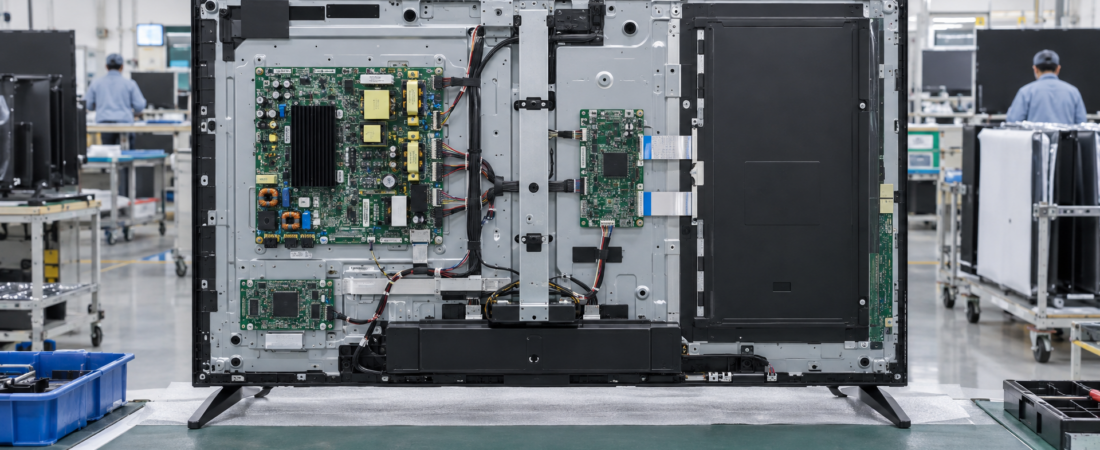
According to a September 30 DigiTimes report, a global memory shortage driven by surging AI infrastructure spending has pushed semiconductor costs above display panel costs in some television models. That is a notable reversal in TV manufacturing economics. In a category where panel pricing has long been one of the main cost anchors, the report suggests that chip availability and pricing are now exerting greater pressure on at least part of the bill of materials.
The significance extends beyond televisions. If memory tightness linked to AI buildouts is strong enough to alter costs in a mature consumer device segment, it suggests that the impact of AI capital spending is spreading well beyond servers and accelerators. In other words, demand created upstream in data centers may now be influencing cost structures downstream in consumer electronics.
For Asia, the development matters because the region sits at the center of both memory production and electronics manufacturing. The report flags South Korea and Taiwan as relevant geographies, and names Samsung Electronics and LG Electronics as related companies. The available information does not specify which TV models are affected, the exact cost breakdown, or how long the inversion may last. Even so, the reported shift is strategically important because it points to a broader question: how far AI-driven component tightness can travel across the hardware supply chain.
Watch the Short Brief
Watch this short visual briefing for the key strategic implications behind the story.
Key Developments
According to the available source information, the immediate trigger is a global memory shortage tied to heavy AI infrastructure spending. The reported effect is that semiconductor costs have overtaken display panel costs as the primary cost driver in some TV models.
That inversion matters because it runs against the usual logic of TV manufacturing. Panels have typically been treated as the dominant hardware cost in television assembly, especially in a price-sensitive and highly competitive market. If the report is accurate, the balance has shifted enough that chips now matter more than panels in at least some configurations.
The source associates the story with Samsung Electronics and LG Electronics, as well as South Korea and Taiwan. The available information, however, does not provide model-level details, company statements, quantified exposure, or a clear timeframe for the shortage. It also does not spell out Taiwan’s precise role in this specific cost change. Those gaps do not negate the reported development, but they do mean the broader implications should be interpreted with caution.
Strategic Analysis
The core strategic message is not simply that TV components have become more expensive. It is that AI spending may be strong enough to reorder cost priorities in products that have little direct connection to AI workloads. That is an important supply-chain signal.
Television manufacturing is a useful case study because it is a mature business with limited room for cost shocks. Pricing is competitive, differentiation is often incremental, and manufacturers typically manage around tight hardware margins. In that kind of market, a change in the largest input cost is not a routine event. If semiconductors are now overtaking panels in some models, the implication is that memory tightness is no longer a niche problem confined to cloud infrastructure procurement.
One analytical implication is that the AI buildout may be reshaping semiconductor scarcity in more indirect ways than headline market narratives usually capture. The public focus is often on AI accelerators, advanced packaging, and data-center servers. But memory is a foundational input across a far wider range of devices. If AI infrastructure demand absorbs a larger share of available memory supply, or pushes pricing higher across the market, the consequences can surface in products that have no AI premium attached to them and little pricing power to offset cost increases.
That matters especially in Asia. South Korea is central to the memory industry, and Samsung Electronics also has direct exposure to consumer electronics. For Samsung, the reported development could be strategically complex: tighter memory conditions may support parts of the component business while raising costs on the device side. LG Electronics, while not a memory producer on the same scale, is relevant as a consumer electronics manufacturer exposed to downstream component pricing. The report’s inclusion of Taiwan also highlights Asia’s broader manufacturing centrality, even if the available source information does not define Taiwan’s exact role in this case.
This should not be overstated into a claim that AI has permanently rewritten all TV economics. The available evidence is narrower than that. The report refers to some models, not the entire market, and it does not provide exact cost ratios or duration. The more defensible interpretation is that the TV industry may be experiencing an early signal of a wider resource-allocation problem: when AI infrastructure spending rises sharply, other hardware categories can feel the effects through shared component markets.
If that reading holds, the strategic issue is less about televisions themselves and more about transmission mechanisms inside the semiconductor economy. Memory price pressure can travel quickly because it touches multiple end markets at once. When that pressure becomes visible in a product category as mature as TVs, it suggests that procurement teams, OEMs, and investors may need to pay closer attention to second-order effects from AI spending rather than focusing only on first-order beneficiaries.
A further implication is around margin resilience. Panels, while cyclical, are a familiar variable in TV planning. A semiconductor-led cost shock is more disruptive because it can arrive from outside the traditional display cycle and may be harder for TV brands to hedge, absorb, or pass through. If memory remains tight, manufacturers could face difficult trade-offs around product mix, promotional pricing, and inventory strategy. Whether that develops into a broader consumer electronics issue will depend on how persistent the shortage proves to be.
Investor Takeaway
The reported cost inversion should be treated as a meaningful signal, but not yet as conclusive evidence of a lasting sector-wide reset. Investors should watch four questions.
First, is this limited to a narrow set of TV models, or does it spread across more price tiers and brands? Breadth will determine whether the issue is episodic or structurally relevant.
Second, do major electronics companies begin to discuss memory-related cost pressure more explicitly in consumer device commentary? For Samsung Electronics and LG Electronics, the key issue is whether higher semiconductor input costs start to influence margins, pricing discipline, or product positioning.
Third, does memory tightness remain linked to AI infrastructure spending over multiple quarters? If the shortage eases quickly, the TV cost inversion may prove temporary. If it persists, investors may need to reassess how AI demand affects hardware segments beyond servers and accelerators.
Fourth, does the disruption remain contained to televisions, or does it appear in other mature electronics categories? The broader the spillover, the stronger the case that AI capital flows are beginning to reshape component economics across the consumer hardware stack.
The most important takeaway is that this story is not really about television panels losing relevance. It is about memory becoming scarce enough, and expensive enough, to alter long-standing manufacturing assumptions in another industry. In Asia’s technology supply chain, that is the kind of shift worth watching closely.