Executive Summary
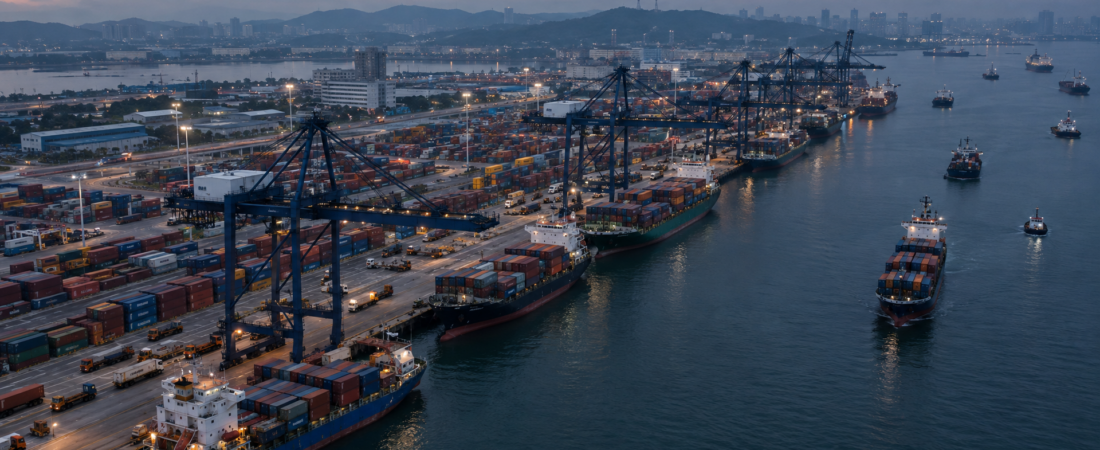
Intra-Asia container shipping rates remain elevated, according to the reported source information, even as global spot rates on some longer-haul routes show signs of stabilizing. The report attributes that resilience in regional freight pricing to two pressures: persistent port congestion and higher bunker fuel costs.
For Asia’s technology supply chains, that divergence matters. Regional manufacturing networks in electronics and semiconductors depend on frequent short-haul container movements between China, Southeast Asia, and other production hubs. When intra-Asia rates stay high while headline long-haul shipping costs ease, logistics pressure does not disappear from the system; it shifts closer to the production base.
That does not by itself confirm a lasting structural reset in regional shipping economics. But it does suggest that companies with multi-stage, cross-border manufacturing footprints may continue to face cost and timing friction even if broader global freight markets appear calmer.
Watch the Short Brief
Watch this short visual briefing for the key strategic implications behind the story.
Key Developments
According to the available source information, intra-Asia container shipping rates are still holding at elevated levels.
The reported drivers are continued port congestion and rising bunker fuel costs. In practical terms, that points to both operational disruption and input-cost pressure affecting regional freight pricing at the same time.
The source also indicates a contrast with long-haul markets, where global spot rates on some major routes are showing signs of stabilization. That creates an important distinction: easing conditions on transpacific or other headline trade lanes do not necessarily translate into relief within Asia’s regional shipping network.
The implications are most relevant for Asia-focused supply chains, especially those tied to China and Southeast Asia, where production is spread across multiple jurisdictions and intermediate goods often move several times before final export.
No specific rate data, port-level bottlenecks, or duration estimates were provided in the available source information. As a result, the most defensible conclusion is not that intra-Asia shipping has entered a new long-term regime, but that current regional conditions remain tighter than broader top-line freight indicators might suggest.
Strategic Analysis
The key strategic issue is not simply that shipping costs are high. It is that the pressure is concentrated in the regional links that underpin Asia’s manufacturing model.
For technology supply chains, intra-Asia shipping is not a secondary logistics layer. It is part of the production architecture. Electronics, hardware, and semiconductor-related goods frequently move between different countries for component sourcing, subassembly, packaging, testing, and final assembly. That means regional freight costs can accumulate across multiple legs before a finished product ever reaches an intercontinental export route.
This is why stabilization in long-haul shipping rates can be an incomplete signal for Asia technology operators. A company may see less stress in outbound freight to the US or Europe while still absorbing elevated costs inside Asia. In some cases, the more meaningful margin pressure may come from the repeated movement of intermediate goods across regional production nodes rather than from the final export leg.
The reported combination of congestion and costlier bunkers is also notable because it reflects two different forms of strain. Congestion points to physical and scheduling inefficiency at ports and terminals. Higher bunker costs point to fuel-related pricing pressure that carriers can pass through to customers. When both are active at once, shippers may face not only higher nominal rates but also less predictable transit planning.
For semiconductor and electronics supply chains, that uncertainty can matter nearly as much as the freight bill itself. Production systems built around tightly sequenced component flows are vulnerable to delays at transfer points. Even modest disruption in regional shipping can complicate inventory management, stretch lead times, and force manufacturers to hold more buffer stock. That is particularly relevant in sectors where production is geographically fragmented across East Asia and Southeast Asia.
One implication is that intra-Asia freight should be watched as a separate indicator rather than as a derivative of global container market trends. Too much freight analysis still centers on benchmark long-haul routes because they are more visible and often better covered. But for companies operating inside Asia’s manufacturing web, regional container conditions may be a better real-time measure of supply-chain friction.
Another implication is that supply-chain diversification inside Asia does not automatically reduce logistics exposure. Much of the recent discussion around China-plus-one strategies and Southeast Asian manufacturing expansion has focused on geopolitical resilience, labor costs, and tariff positioning. But a more distributed regional footprint can also increase the number of cross-border logistics handoffs. If regional congestion and fuel costs remain elevated, those more complex footprints may carry a hidden cost.
That does not mean regional diversification is the wrong strategy. It does suggest that the benefits depend partly on whether logistics networks can support a more fragmented production map without persistent cost inflation. If not, some manufacturers may need to reassess the trade-off between geographic spread and operational efficiency.
There is also a capital allocation angle. If intra-Asia shipping stays expensive or unreliable, companies may face stronger incentives to invest in inventory buffers, supply-chain software, route redesign, or production clustering closer to final assembly. In technology manufacturing, where working capital discipline and cycle times matter, even a modest increase in logistics friction can influence where incremental capacity is placed.
At the same time, it is important not to overstate the evidence. The currently available information supports the view that intra-Asia rates are elevated because of congestion and fuel costs. It does not yet establish whether this is a seasonal dislocation, a medium-term imbalance, or a more durable reset. The distinction matters. Temporary tightness calls for tactical mitigation; structural change would have broader implications for manufacturing footprints, pricing power, and supply-chain design.
Investor Takeaway
The most important takeaway for investors is that freight normalization at the global headline level may not fully capture conditions inside Asia’s technology supply chains.
If the reported trend persists, the companies most exposed are likely to be those with high-frequency intra-regional component movements. That includes electronics manufacturers, contract manufacturers, and semiconductor-related operations that rely on multiple production stages across different Asian markets. The issue is not only higher shipping expense. It is the possibility of cumulative friction across procurement, assembly, and delivery schedules.
Investors should monitor several signals.
First, whether port congestion in key Asian hubs shows signs of easing in coming months. If congestion recedes while rates remain elevated, fuel or carrier pricing may be doing more of the work. If congestion persists, the operational risk case becomes stronger.
Second, bunker fuel trends matter because they shape the cost base for regional carriers and the likelihood of surcharges being sustained. Continued fuel pressure could keep intra-Asia freight firmer than expected even in a softer global rate environment.
Third, investors should watch company commentary rather than relying only on freight indices. Management teams in electronics, hardware, and semiconductor supply chains are more likely to reveal whether regional shipping is affecting lead times, inventory strategy, or margin performance.
Fourth, it will be important to track whether elevated intra-Asia logistics costs begin influencing manufacturing geography. If companies increasingly cluster production steps within fewer countries or closer to major export nodes, that could indicate logistics friction is starting to shape industrial planning.
The broader strategic point is straightforward: Asia’s technology system depends on dense regional circulation, not just long-distance export capacity. According to the reported information, that regional circulation is still under cost pressure. If confirmed over multiple periods, that could become a more meaningful constraint on supply-chain efficiency than the stabilization now visible on some global shipping routes.
For now, the prudent interpretation is that intra-Asia freight remains an underappreciated variable in Asia technology intelligence. It may not yet represent a confirmed structural shift, but it is clearly a signal worth watching more closely.