Executive Summary
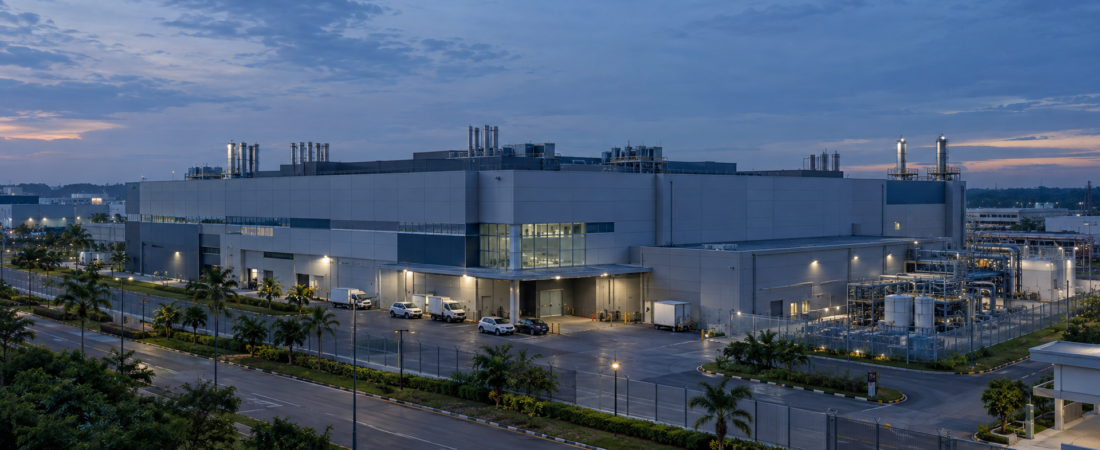
VisionPower Semiconductor Manufacturing Company, the joint venture between Vanguard International Semiconductor and NXP Semiconductors, has opened its first 300mm wafer fabrication facility in Tampines, Singapore. According to the available source information, the fab has entered risk production and is targeting monthly capacity of 44,000 wafers by 2029.
This matters less as a single-site opening and more as a signal of how specialty semiconductor manufacturing is evolving in Asia. The reported structure combines Taiwan-linked manufacturing expertise, NXP’s demand visibility in automotive and industrial chips, and Singapore’s role as a lower-risk production location within the regional semiconductor map.
One strategic implication is that NXP appears to be seeking more direct influence over mature and specialty-node supply rather than relying only on external foundry allocation. For Asia’s semiconductor ecosystem, the project also highlights a broader pattern: capacity diversification is increasingly being pursued through joint ventures, licensing, and geographically distributed manufacturing rather than through fully independent process development.
Watch the Short Brief
Watch this short visual briefing for the key strategic implications behind the story.
Key Developments
VSMC has opened its first 300mm fab in Tampines, Singapore, adding a new specialty manufacturing asset to Southeast Asia’s semiconductor base.
The company is a joint venture between Taiwan-based specialty foundry VIS and NXP Semiconductors, a major supplier to automotive and industrial end markets.
According to the report, the fab has entered risk production, which typically marks the stage before larger-scale commercial manufacturing as companies validate process stability and production readiness.
The available source information indicates the facility is targeting capacity of 44,000 wafers per month by 2029, pointing to a multi-year ramp rather than an immediate full-capacity launch.
The report also indicates the fab is using TSMC-licensed processes. If sustained in practice, that would reinforce a hybrid model in which process technology, operating know-how, and capacity ownership are distributed across different corporate structures.
What is not specified in the available information is also important. The source package does not provide capital expenditure figures, node details, incentive terms, customer commitments beyond the founding relationship, or a detailed production mix. That limits how far investors should go in drawing short-term financial conclusions from the opening alone.
Strategic Analysis
The Singapore fab opening is best understood as part of a wider shift in how mature and specialty semiconductor capacity is being secured across Asia. Leading-edge logic still attracts most market attention, especially in the AI era, but automotive, industrial, power, and embedded systems continue to depend heavily on older or specialized manufacturing technologies. Those categories are less glamorous than frontier AI accelerators, but they remain critical to vehicle production, factory automation, energy infrastructure, and connected devices.
In that context, VSMC’s new fab may indicate a more deliberate effort by NXP and VIS to combine stable demand, foundry capability, and location diversification in a single operating structure. For NXP, partial control over production capacity could reduce exposure to the allocation risk that can emerge when merchant foundry supply tightens. During past semiconductor shortages, mature-node constraints created outsized disruption for automakers and industrial equipment producers, even when the constrained chips were far from cutting-edge.
For VIS, the project appears to extend its role beyond Taiwan while preserving links to Taiwan’s manufacturing ecosystem. That matters because the semiconductor industry’s next phase in Asia is not simply about replacing Taiwan or decoupling from it. In many cases, the pattern is more nuanced: process technology and engineering links remain tied to Taiwan, while incremental production is placed in other jurisdictions to improve resilience.
That is where Singapore becomes strategically significant. The city-state has long positioned itself as a trusted semiconductor manufacturing base, with established infrastructure, relatively strong policy continuity, and a reputation for operational reliability. A new 300mm fab there reinforces Singapore’s standing as a serious node for specialty and mature semiconductor production, especially for companies seeking geographic diversification without abandoning Asian supply-chain density.
This does not mean Singapore is becoming a substitute for Taiwan’s semiconductor role. Rather, it suggests Singapore is strengthening its position as a complementary production location within an Asia-centered network. That distinction matters. Much of the industry’s real-world diversification is not full relocation; it is layered redundancy. Companies want more than one manufacturing geography, but they also want to preserve the efficiency, supplier depth, and technical ecosystems that Asia already offers.
The reported use of TSMC-licensed processes fits this interpretation. If accurate, it points to a model in which companies can accelerate capacity build-out without bearing the full cost and technical risk of developing process technology independently. That may be especially relevant for specialty manufacturing, where competitive advantage often depends less on absolute node leadership and more on cost control, reliability, qualification discipline, and long product life cycles.
From a capital-allocation perspective, the fab also highlights a practical industry response to a structurally different environment. Semiconductor manufacturers are being pushed to invest not only for growth, but also for resilience. That changes the logic of capacity decisions. A fab outside a company’s legacy manufacturing footprint may not exist purely to maximize near-term margin. It may also exist to reduce concentration risk, protect strategic customers, and secure supply optionality over a longer horizon.
The long ramp to 2029 is therefore important. It suggests this is not a short-term answer to a temporary demand spike. It looks more like infrastructure planning for a world in which supply assurance carries higher strategic value than it did before the industry’s recent disruptions. Investors should read that as a sign of how slowly semiconductor geography changes and how seriously companies are now treating resilience as part of manufacturing strategy.
At the same time, the opening should not be overstated. A single fab does not by itself redraw Asia’s semiconductor balance. The absence of detailed disclosure on node mix, customer base, economics, and incentive support means the investment case cannot rest on broad assumptions about immediate profitability or market-share impact. The more defensible conclusion is that this is a meaningful structural move whose full commercial importance will only become clearer during the ramp.
Investor Takeaway
The most useful way to read the VSMC fab opening is as an early indicator of where specialty semiconductor strategy in Asia may be headed. It points toward a model built on co-owned capacity, selective technology licensing, and geographic diversification within the region rather than outside it.
For NXP, the key question is whether this facility meaningfully improves supply control for automotive and industrial products over time. If it does, that could strengthen resilience in product segments where continuity often matters more than leading-edge performance.
For VIS, investors should monitor whether the Singapore project expands its strategic relevance beyond a conventional foundry role and helps it participate more directly in the regional push for diversified manufacturing footprints.
For Singapore, the project supports the broader investment case that Southeast Asia can capture more semiconductor value through specialty and mature-node capacity, even as the most advanced logic remains concentrated elsewhere.
Several markers will matter from here. Investors should watch whether the fab progresses from risk production to stable commercial output, whether the ramp toward 44,000 wafers per month stays on track, and whether additional customer relationships or expansion plans emerge over time. It will also be important to see whether similar licensing-and-joint-venture structures are used elsewhere in Asia, particularly in segments tied to automotive, industrial, and power semiconductors.
The broader takeaway is not that a new semiconductor center has suddenly displaced existing leaders. It is that Asia’s manufacturing map is becoming more layered. Taiwan remains central, but projects such as VSMC suggest that more companies want capacity anchored across multiple Asian jurisdictions. In a market where resilience, supply assurance, and geopolitical diversification now shape capital decisions alongside cost and technology, that may prove to be the more important signal.