Executive Summary
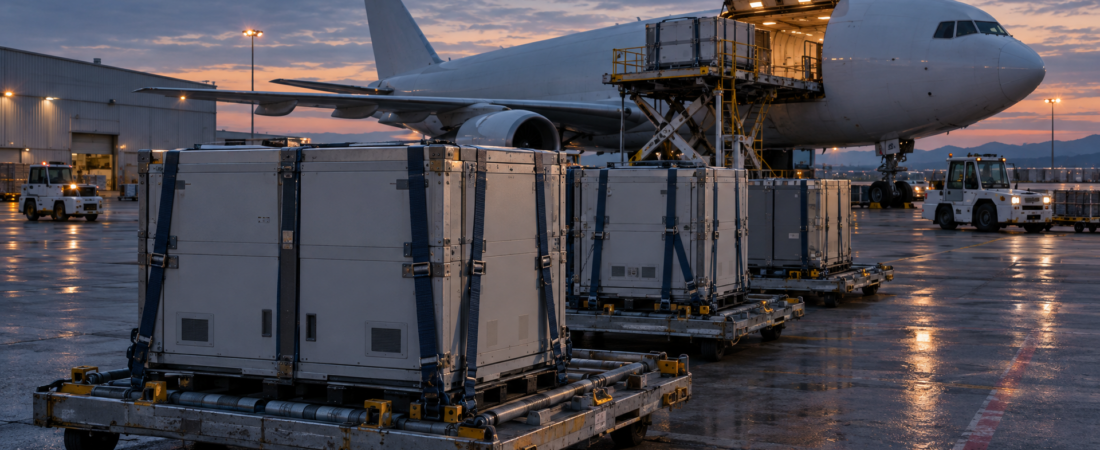
The AI infrastructure buildout is increasingly visible not only in chip demand and data center spending, but also in the trade networks that move high-value hardware across the Pacific. According to the available source information, sourcing tied to semiconductors and data center hardware accounted for 42% of global goods trade growth. The same report suggests this demand is pushing logistics carriers to double trans-Pacific precision shipping and automated hub capacity in Asia.
That matters because AI deployment depends on physical systems before it becomes a software story. Advanced semiconductors, servers, networking equipment, and related components all have to move from manufacturing centers to installation sites on tight schedules and with limited tolerance for delay or handling errors. If AI-linked hardware is now driving such a large share of trade growth, logistics capacity becomes more than a background operational issue. It becomes part of the strategic stack.
For Asia, the implications are especially important. Taiwan and South Korea sit near the center of the semiconductor and advanced electronics supply chain, while the United States remains a major end market for AI infrastructure deployment. The reported shift suggests that trans-Pacific freight networks may become an increasingly important indicator of how efficiently the AI buildout can scale.
Watch the Short Brief
Watch this short visual briefing for the key strategic implications behind the story.
Key Developments
According to the source summary, sourcing for semiconductors and data center hardware represented 42% of global goods trade growth. Even without further methodological detail in the available material, that is a notable concentration of trade expansion around AI-related hardware categories.
The same source indicates that this surge is pushing global logistics carriers to double trans-Pacific precision shipping and automated hub capacity in Asia. The available information does not specify route-level changes, individual hub locations, or the timing and scale of carrier investments, but it does point to a more specialized logistics response tied to high-value electronics flows.
FedEx and UPS are identified in the source package as related companies. However, the available information does not confirm specific actions, capital commitments, or service changes by either company. Their relevance is best understood in general terms: both are major global carriers with exposure to time-sensitive and high-value freight.
The regional lens also matters. Taiwan and South Korea are cited as relevant origins, which aligns with their central roles in semiconductor and electronics manufacturing. The United States is identified as the key destination region in the source package, consistent with its importance in AI infrastructure spending and data center expansion.
Taken together, the report suggests that the AI hardware cycle is becoming visible in freight architecture, not just in fab utilization, server orders, or capital expenditure plans.
Strategic Analysis
The most important takeaway is that AI infrastructure may be creating a more demanding logistics profile than many investors and industry observers have fully priced in. Chips and servers are often discussed in terms of design leadership, fabrication capacity, packaging, and compute demand. But those advantages only translate into deployed systems if the hardware can move reliably across borders and into operating environments on schedule.
That does not mean the sector is already facing a confirmed logistics bottleneck. The available source information is not detailed enough to support that conclusion on its own. What it does suggest is that AI-related hardware is becoming important enough within global trade flows to influence how carriers think about capacity, automation, and service precision.
One implication is that not all electronics freight should be treated equally. AI accelerators, advanced memory, server assemblies, and data center components are typically higher value, more time-sensitive, and more operationally critical than a broad range of standard consumer electronics shipments. If the reported trend is accurate, carriers may increasingly differentiate between ordinary volume freight and premium hardware flows that require tighter handling, faster routing, or more automated sorting and tracking.
That would be strategically significant for Asia. Taiwan and South Korea are not simply manufacturing locations in this context; they are origin points for a category of freight that may be gaining outsized importance in the global technology economy. If more logistics resources are directed toward these corridors, the result could be a more visible link between semiconductor concentration in East Asia and freight system concentration across the Pacific.
This also widens the definition of supply-chain resilience. In AI, resilience is often framed around foundry dependence, packaging capacity, export controls, and power availability for data centers. The reported logistics response suggests another layer deserves attention: whether the physical movement of hardware can keep pace with procurement and installation cycles. If the freight system becomes less predictable, that could complicate infrastructure schedules even when chip output itself remains strong.
There is also a capital allocation angle. Automated hub capacity in Asia, as described in the source summary, implies that logistics infrastructure may be adjusting to handle more specialized and potentially higher-value throughput. If that pattern continues, investors may need to watch whether logistics operators direct more spending toward automation, network optimization, and premium handling capabilities linked to semiconductor and server traffic.
The geopolitical dimension should not be overstated, but it should not be ignored either. When a larger share of trade growth is tied to semiconductors and data center hardware, trade corridors linked to Taiwan, South Korea, and the United States may become even more strategically sensitive. Any disruption involving shipping routes, port operations, customs flows, or broader trade relations could have amplified consequences if those corridors are carrying a greater share of critical AI infrastructure inputs.
A final implication is analytical rather than operational. AI demand is often measured through chip sales, cloud capex, or model launches. Freight patterns may now offer an additional way to read the buildout. If trans-Pacific precision shipping and hub automation continue to expand alongside semiconductor and server demand, logistics data could become a useful secondary signal for where AI infrastructure growth is most intense.
Investor Takeaway
The reported development is best understood as an early signal that logistics is becoming more strategically relevant to the AI hardware economy. It does not yet confirm a lasting freight bottleneck or a definitive change in carrier economics. But it does suggest that supply-chain analysis around AI should extend beyond fabs and data centers to include the networks connecting them.
For investors, several indicators are worth monitoring.
First, watch whether major logistics operators describe sustained growth in semiconductor and data center hardware shipments, especially on trans-Pacific routes. Carrier commentary on premium handling, network automation, and Asia hub utilization would help clarify whether the trend is becoming structural.
Second, track whether semiconductor and hardware manufacturers in Taiwan and South Korea make more frequent reference to freight reliability, lead times, or shipping complexity. Even limited operational commentary could offer useful clues about whether logistics is becoming a larger planning variable.
Third, follow whether U.S.-bound AI infrastructure deployment appears increasingly sensitive to cross-border hardware movement. The available source information does not establish a direct causal link to project delays, but if logistics becomes more specialized, the pace of deployment may depend not only on hardware availability but also on transport execution.
Fourth, monitor whether freight capacity expansion is broad-based or concentrated in a narrow premium tier. If the response remains targeted, that may support the view that AI hardware is creating a distinct logistics segment with different economics from standard electronics shipping.
The broader point is that AI infrastructure is a physical buildout as much as a digital one. According to the report, semiconductors and data center hardware are already accounting for a large share of global goods trade growth. If that pattern holds, trans-Pacific logistics will matter more to semiconductor strategy, supply-chain resilience, and capital allocation decisions across the AI ecosystem.