Executive Summary
According to the available source information, GlobalFoundries has secured a reported US$2 billion agreement to supply TSMC with interposers made on mature process nodes, with the arrangement intended to help address a US advanced packaging capacity gap tied to AI hardware.
If accurate, the significance of the deal is less about leading-edge wafer competition and more about where the next AI bottleneck sits. AI accelerators depend not only on advanced logic, but also on the packaging layers that connect compute dies with high-bandwidth memory. That makes interposers and related packaging components strategically important even when they are produced on older nodes.
For Asia’s semiconductor ecosystem, the reported arrangement points to a broader shift in value across the supply chain. Taiwan remains central to advanced chip production, but the packaging stack around AI hardware is becoming a more contested arena for capacity, geography, and industrial policy. The reported use of mature-node capacity for interposer production may also reshape how investors think about legacy fabs, which are often viewed through the lens of slower-growth end markets.
The direct implications for China are less clear from the available information. Still, one reasonable interpretation is that any expansion of non-China packaging-related capacity for AI systems could matter geopolitically, especially as supply-chain resilience and export-control risk continue to influence semiconductor strategy.
Watch the Short Brief
Watch this short visual briefing for the key strategic implications behind the story.
Key Developments
According to the report summary, the core development is a reported US$2 billion deal under which GlobalFoundries will supply TSMC with interposers manufactured on mature process nodes. The same summary says the purpose is to bridge a US advanced packaging capacity gap relevant to AI hardware.
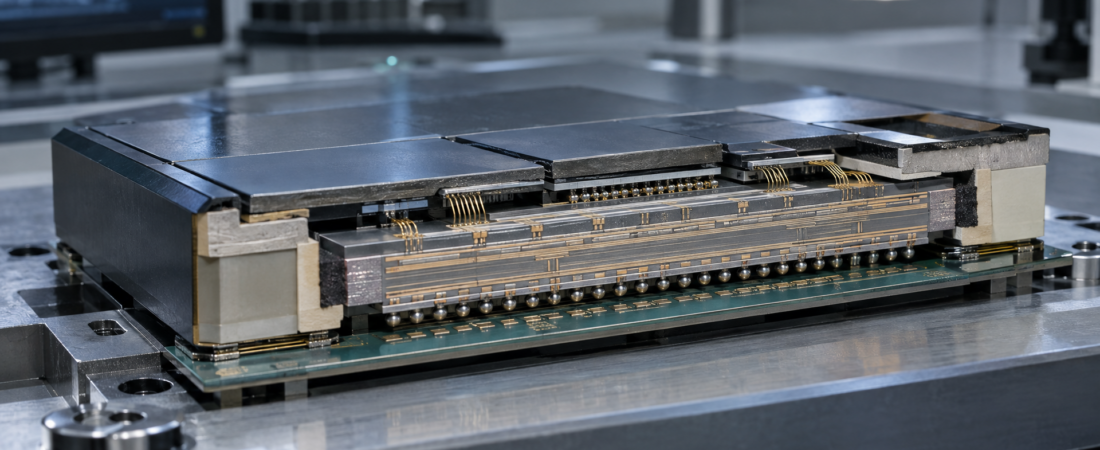
That matters because interposers are a key part of advanced chip packaging. In AI accelerators, they help connect logic and memory components inside a single package, enabling the dense, high-bandwidth architectures required for modern training and inference systems.
The companies named in connection with the development are TSMC, GlobalFoundries, and Nvidia. However, based on the available information, Nvidia should be treated as a contextually relevant company in the AI accelerator ecosystem rather than a confirmed direct party to the reported arrangement.
The relevant geographies are Taiwan, the United States, and China. Taiwan is central because of TSMC’s role in the semiconductor manufacturing stack. The United States matters because the report frames the arrangement as addressing a US packaging-related capacity gap. China matters as a strategic reference point, though the available information does not specify a direct operational effect on Chinese firms or facilities.
Several specifics remain unconfirmed in the available source material. These include contract duration, production volume, facility location, node designation, and timing of any ramp. For that reason, the reported value of the deal and its strategic implications should be read as source-attributed rather than independently confirmed facts.
Strategic Analysis
The most important signal in the reported deal is that mature-node capacity may be gaining new strategic value through advanced packaging rather than through conventional wafer demand alone.
For much of the semiconductor cycle, mature nodes have typically been discussed in the context of automotive, industrial, power management, and other established end markets. The reported TSMC-GlobalFoundries arrangement suggests a different use case: older process technologies supporting one of the fastest-growing parts of the semiconductor economy by producing interposers for AI packages. If that model proves durable, the industry may need to think less in terms of “leading edge versus legacy” and more in terms of which manufacturing steps are becoming binding constraints.
That distinction matters because AI hardware supply has increasingly become a systems problem. The performance of an AI accelerator depends on more than transistor scaling. It also depends on how efficiently compute, memory, and interconnect are assembled and integrated. Even when advanced logic fabrication remains the headline issue, packaging availability can determine how much finished product actually reaches the market.
In that sense, the reported arrangement may indicate that the next layer of semiconductor competition is about orchestration across the stack. Leading-edge foundries, mature-node manufacturers, memory suppliers, and packaging specialists are no longer operating in neatly separated lanes when it comes to AI infrastructure. Instead, value is accumulating at the interfaces between them.
For TSMC, if the reported arrangement is confirmed, it could reflect a pragmatic approach to bottleneck management: preserve internal focus where process leadership matters most, while drawing on external capacity for packaging-related components that do not require frontier transistor density. For GlobalFoundries, the reported deal may point to a path for repositioning mature-node assets around AI-enabling demand rather than relying only on traditional legacy markets.
The Asia angle is especially important. Taiwan remains the anchor of advanced semiconductor manufacturing, but AI supply chains are becoming more distributed in selective ways. If packaging-related work can be separated into different technical layers and assigned across geographies, that could gradually alter how supply-chain resilience is built. It would not displace Taiwan’s centrality, but it could shift some supporting capacity into the United States or other jurisdictions over time.
This is where the China question enters, although caution is necessary. The available source information does not establish a direct China impact, nor does it identify Chinese companies that would be displaced by the reported arrangement. Still, one strategic implication is that any effort to expand non-China, non-single-region capacity for AI packaging inputs fits a broader pattern of semiconductor diversification. In an environment shaped by export controls, national industrial policy, and concerns over concentration risk, even seemingly modest packaging components can take on geopolitical importance.
That does not mean the reported deal changes the competitive balance with China by itself. More likely, if accurate, it should be viewed as one incremental move inside a larger reconfiguration of AI hardware supply chains. The key issue is not whether mature-node interposers are glamorous technology. It is whether they remove enough friction from the packaging stack to matter commercially and strategically.
Another point worth watching is industry structure. The reported transaction may suggest a more modular ecosystem in which foundries cooperate in targeted ways across node and process layers. That interpretation should remain cautious. It is too early, based on the current information, to say such arrangements are becoming standard practice. But if similar deals appear, it would strengthen the case that AI demand is encouraging more specialized and interdependent manufacturing models.
Investor Takeaway
The main takeaway is that AI semiconductor strategy is no longer only about who owns the most advanced node. Packaging-related capacity, including components made on mature nodes, may increasingly shape delivery timelines, revenue conversion, and capital allocation across the AI hardware chain.
For investors, this reported development is most useful as a framework signal. It suggests that mature-node manufacturing assets should not automatically be treated as low-strategic-value capacity if they can be redirected toward AI packaging inputs. It also reinforces the view that bottlenecks can migrate from wafer fabrication to assembly, integration, and memory attachment.
Several areas deserve close monitoring.
First, watch for direct confirmation from TSMC or GlobalFoundries. The reported US$2 billion figure is strategically meaningful, but it remains source-attributed in the available information. Official disclosure on terms, scope, or timing would materially improve confidence in the story.
Second, watch whether other packaging-related partnerships emerge between leading-edge and mature-node manufacturers. If that happens, the reported arrangement would look less like an isolated tactical fix and more like evidence of a broader redesign in semiconductor capacity planning.
Third, monitor whether AI chip companies begin signaling improvement in packaging availability rather than only wafer supply. That would be one of the clearest signs that interposer capacity is becoming commercially relevant at scale.
Fourth, track the policy dimension. If US semiconductor initiatives place greater emphasis on advanced packaging and adjacent components, that would reinforce the interpretation that governments increasingly view packaging as strategic infrastructure rather than a downstream manufacturing detail.
The China angle should be approached with discipline. Investors should not assume a direct negative read-through for Chinese semiconductor players based on the current information alone. The more defensible conclusion is narrower: the reported deal may support a broader diversification trend in AI supply chains, and that trend could matter over time if it deepens across packaging, assembly, and supporting materials.
In short, if the reported arrangement is confirmed, it highlights a structural shift that TechPowerAsia readers should take seriously. In the AI era, mature nodes are not necessarily yesterday’s assets. In the right part of the stack, they may become part of tomorrow’s chokepoint solution.