Executive Summary
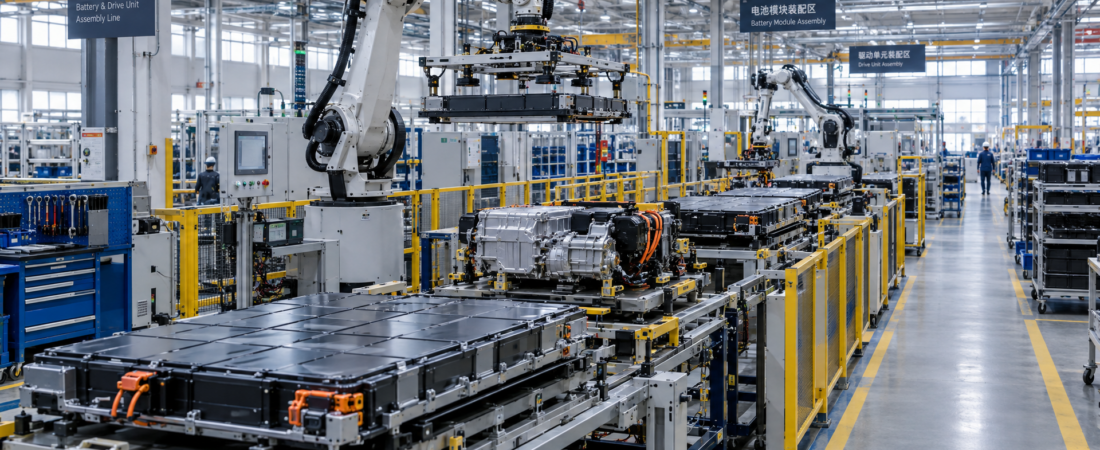
China’s electric vehicle manufacturing ecosystem may be emerging as a practical foundation for industrial humanoid robotics. According to DIGITIMES Insights, Chinese automakers are pursuing three strategies in humanoid robot development, supported by what the report describes as roughly 60% overlap between EV and humanoid robot supply chains.
That reported overlap matters because it shifts the discussion from robotics as a standalone frontier to robotics as an extension of existing industrial capacity. If the DIGITIMES assessment is accurate, Chinese manufacturers may be able to reuse parts of their EV supplier base, motor systems, and embodied AI capabilities instead of building entirely separate robotics stacks from scratch.
For TechPowerAsia readers, the significance is broader than any one robotics program. The key issue is whether China’s EV scale is starting to function as enabling infrastructure for the next wave of physical AI. If so, the competitive edge would not come only from software or product design, but from supply-chain density, manufacturing experience, and component reuse across adjacent sectors.
This is still an early-stage signal rather than a fully verified market shift. The available source information does not provide details on the three strategies, methodology for the 60% figure, or specific commercialization timelines. Even so, the reported convergence between EVs and humanoid robots points to a potentially important development in China’s industrial AI landscape.
Watch the Short Brief
Watch this short visual briefing for the key strategic implications behind the story.
Key Developments
According to DIGITIMES Insights, Chinese automakers are pursuing three distinct approaches to humanoid robot development. The available source summary does not specify what those approaches are, but it presents the trend as a strategic push by automakers rather than a series of isolated experiments.
The report’s central claim is that EV and humanoid robot supply chains overlap by about 60%. In the available summary, that overlap is linked to components, motors, and embodied AI algorithms. If confirmed, that would suggest a meaningful degree of reuse in both hardware sourcing and manufacturing know-how.
The source summary specifically frames the opportunity around repurposing existing EV supply chains to scale industrial humanoid robotics production. That is an important distinction. The emphasis is on industrial robots rather than consumer humanoids, and on leveraging existing automotive infrastructure rather than constructing a separate robotics manufacturing base from the ground up.
The source packet lists BYD, Tesla, and Xiaomi as related companies, but the available summary does not define their individual roles in the reported three-strategy framework. As a result, the strategic takeaway is more about system-level industrial convergence than about any one company’s confirmed execution path.
What is not yet established in the available information is just as important. The source summary does not include production volumes, investment commitments, named customers, technical specifications, product timelines, or disclosed deployment targets. That limits how far the current reporting can be used to support company-specific conclusions.
Strategic Analysis
The most important implication of the DIGITIMES report is structural. EV manufacturing and humanoid robotics appear, at least in this framing, to share a larger industrial base than many investors may have assumed. Motors, control systems, power management, selected sensors, software integration, and assembly expertise are all areas where adjacent capabilities could plausibly transfer from electric vehicles to industrial robotics.
If that transfer is real at scale, it could lower some of the usual barriers to entry in humanoid robotics. The cost advantage would not necessarily come from a breakthrough robot design alone. It could come from access to an established supplier network, procurement scale, process engineering talent, and factory systems already optimized for high-volume electromechanical production.
That matters especially in China, where EV competition has already driven rapid iteration in manufacturing, supply-chain coordination, and component sourcing. In that context, the reported overlap may indicate that humanoid robotics is not developing as a clean-sheet industry. Instead, it may be emerging as a derivative layer on top of an already scaled industrial platform.
For Asia-focused technology intelligence, this is a useful reminder that strategic advantage often compounds across sectors. Capacity built for one national priority can become a launchpad for another. In semiconductors, the same fabs and packaging ecosystems support multiple downstream applications. In AI infrastructure, data center buildouts often create second-order advantages in software and services. The DIGITIMES framing suggests a similar pattern could be forming in physical AI: EV manufacturing depth may now be feeding into robotics.
That possibility also has implications for how investors assess embodied AI. Much of the public discussion around humanoid robots focuses on model performance, autonomy, or product demos. Those elements matter, but they are only part of the equation. A robotics platform also depends on whether actuators, motors, power systems, assembly lines, and suppliers can be scaled economically. The reported EV overlap suggests the manufacturing side of the equation may be more advanced in China than headline narratives about robotics software alone would imply.
At the same time, the report should not be read as proof that commercialization is close at hand. Supply-chain overlap does not automatically solve the hardest robotics problems. Embodied AI still requires robust perception, planning, control, safety, and real-world task reliability. Industrial customers will care about uptime, total cost of ownership, and deployment economics, not just component commonality with EVs.
That is why the 60% figure, while strategically interesting, should be interpreted carefully. Even if hardware and supplier overlap is substantial, the remaining gap could still contain the most difficult and value-critical elements of the robotics stack. In other words, shared manufacturing inputs may accelerate development, but they do not by themselves confirm a near-term mass market.
The geopolitical dimension is also worth watching. If industrial humanoid robotics can be advanced through pre-existing EV ecosystems, then China’s strength may come less from a single policy measure and more from accumulated industrial coordination across batteries, motors, control electronics, and manufacturing systems. That kind of advantage can be harder for competitors to replicate quickly because it is embedded in years of ecosystem development rather than a single announced program.
From a capital-allocation perspective, this could gradually change where value is expected to accrue in robotics. Investors may need to look beyond pure software narratives and track the companies and supply chains that can translate embodied AI into manufacturable, serviceable hardware. The report suggests that the bridge between automotive manufacturing and robotics may become a more important part of that equation in China.
Investor Takeaway
The DIGITIMES report should be treated as an early strategic signal with potentially meaningful implications for China’s AI and manufacturing landscape.
First, investors should monitor whether the reported 60% overlap can be validated through additional disclosures, supplier commentary, or more detailed reporting. The claim is significant because it implies that humanoid robotics could draw on existing EV industrial infrastructure rather than requiring a fully separate buildout.
Second, the undefined “three strategies” deserve close attention. The strategic implications would differ materially depending on whether automakers are pursuing internal development, supplier-led partnerships, manufacturing services, platform licensing, or other models. Until those strategies are clearer, broad conclusions about competitive positioning remain premature.
Third, the software layer remains a key uncertainty. The available source summary links embodied AI algorithms to the overlap thesis, but the transferability of automotive-adjacent AI capabilities into useful humanoid autonomy is not yet demonstrated in the source material. Investors should watch whether hardware convergence is matched by software maturity.
Fourth, commercialization signals will matter more than concept narratives. The clearest indicators would include disclosed production targets, named industrial use cases, factory deployment data, or explicit capex tied to humanoid robot manufacturing. Without those markers, the trend remains strategically notable but not yet operationally proven.
Finally, this development reinforces a broader Asia technology theme: industrial power increasingly comes from cross-sector ecosystem leverage. If EV supply chains can support robotics, then China’s advantage may lie not only in any one product category, but in its ability to reuse scale across adjacent technologies. That is the deeper signal behind the DIGITIMES report, and it is the point investors should keep under review.