Executive Summary
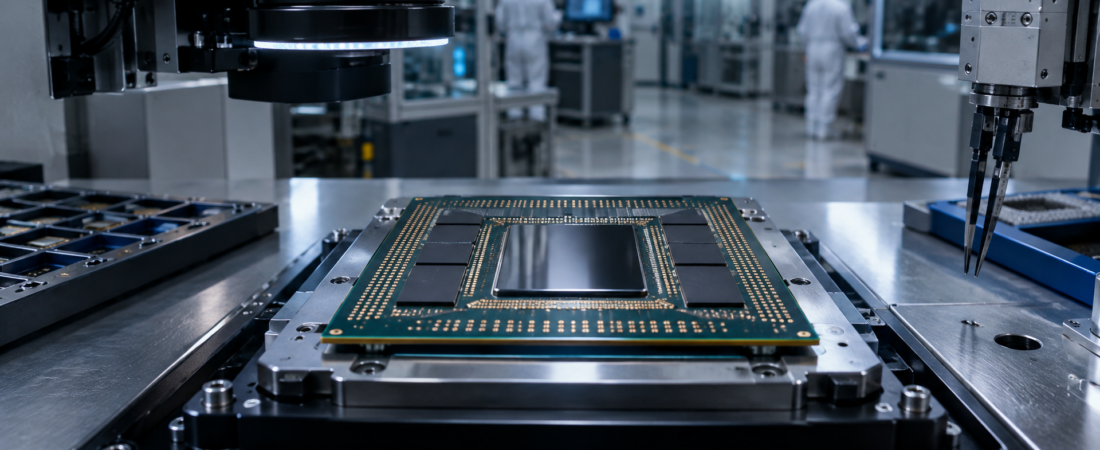
ByteDance’s domestic AI chip push is reportedly running into a bottleneck that sits beyond chip design and wafer production: advanced packaging substrates. According to the available source information, the company’s ambitions are being constrained by a shortage in this part of the supply chain, and ByteDance is planning annual substrate purchases of up to CNY100 billion, or about $14.9 billion, by 2030.
That reported spending plan matters less as a standalone procurement figure than as a signal about where pressure may now be building in China’s AI hardware stack. Public discussion of China’s semiconductor constraints has often centered on lithography, foundry capability, and access to leading-edge manufacturing tools. This development suggests the next limiting factor may also include packaging inputs that are required to convert designed and fabricated silicon into deployable AI accelerators.
If accurate, the ByteDance case points to a broader strategic issue for China’s AI buildout: progress in chip design and fabrication does not automatically remove downstream bottlenecks. In practical terms, substrate availability could become a gating factor for scaling AI compute, especially as Chinese firms try to localize more of the hardware stack.
The strategic takeaway for Asia technology watchers is straightforward. The semiconductor race is no longer defined only by front-end manufacturing. Packaging materials, process capacity, and component sourcing may increasingly shape who can scale AI infrastructure and at what speed.
Watch the Short Brief
Watch this short visual briefing for the key strategic implications behind the story.
Key Developments
According to the source summary, ByteDance’s domestic AI chip ambitions are being constrained by a shortage of advanced packaging substrates. The report frames this as a severe bottleneck affecting the company’s ability to advance its AI hardware plans.
The same source information says ByteDance is planning annual substrate purchases of up to CNY100 billion by 2030. At roughly $14.9 billion using the figure provided in the source summary, that would represent a very large long-term procurement effort if the plan is carried through.
The available materials also list Huawei HiSilicon and Hygon Information Technology as related companies. However, the source information provided here does not specify their exact role in ByteDance’s procurement plans or confirm that they face the same operational constraint in the same way.
China and Taiwan are listed as related regions in the source materials. That indicates a possible regional supply-chain dimension, although the available summary does not spell out the exact structure of supplier exposure, sourcing routes, or commercial dependencies.
Beyond those reported points, the source set does not provide technical detail on substrate type, supplier names, packaging format, production timetable, or contract structure. That limits how far the analysis can go on company-specific execution.
Strategic Analysis
The significance of this report lies in what it suggests about the evolving structure of AI chip competition. In modern AI semiconductors, performance is not determined only by transistor density or process-node leadership. Advanced packaging has become a critical layer in translating silicon into usable compute products, particularly for high-performance workloads where power delivery, thermal management, and die integration matter.
Substrates are a foundational part of that packaging stack. If substrate supply tightens, even a company with chip design ambitions and access to fabrication can still face delays in moving from blueprint to volume deployment. In that sense, the reported shortage is not a peripheral issue. It may indicate that downstream packaging inputs are becoming as strategically important as upstream manufacturing capacity.
For China, that possibility carries wider implications. Much of the external debate around Chinese semiconductor constraints has focused on equipment controls, advanced-node production, and the challenge of replacing foreign manufacturing technology. The ByteDance report suggests another reality: bottlenecks can persist even after those earlier stages, in parts of the value chain that receive less public attention but still determine output.
This matters because AI infrastructure scale depends on the weakest link in the chain, not the strongest. A company may be able to fund design, reserve compute demand, and build software around in-house hardware goals, yet still struggle if a specialized materials segment cannot expand fast enough. If the reported procurement plan reflects genuine scarcity rather than precautionary stockpiling, then substrate access could become a competitive differentiator among large Chinese technology firms.
The reported magnitude of ByteDance’s planned spending reinforces that interpretation, though it should still be treated as a company plan rather than a verified market outcome. A target of up to CNY100 billion in annual purchases by 2030 suggests management may view substrate access as a long-duration strategic issue, not a temporary sourcing problem. Large forward commitments of this kind are often associated with anticipated scarcity, a desire to secure priority allocation, or both.
From a supply-chain perspective, one implication is that semiconductor chokepoints are broadening. Front-end fabrication capacity remains critical, but so do the less visible layers that sit between wafer output and system-level deployment. In the AI era, those layers can matter disproportionately because accelerator performance increasingly depends on complex packaging and integration. That raises the risk that shortages in substrates or other packaging inputs could slow AI infrastructure buildouts even when chip design activity remains strong.
The Asia angle also deserves attention. The source materials identify both China and Taiwan as related regions, which may indicate cross-border relevance in the substrate ecosystem. Based on the available information alone, it is not possible to confirm the exact nature of that relationship. Still, one strategic implication is that packaging-related dependencies may remain regional and specialized, even as China pushes for greater semiconductor self-reliance. If so, that would complicate any assumption that domestic chip ambitions can be insulated simply by advancing wafer manufacturing capability.
The mention of Huawei HiSilicon and Hygon Information Technology is also notable, but it should be handled cautiously. Their presence in the related-company field may signal that the issue has broader ecosystem relevance. At the same time, the available source information does not establish that they are participating in the same procurement strategy or facing an identical shortage profile. For now, the stronger conclusion is simply that ByteDance’s situation may be relevant to other Chinese AI chip efforts, rather than proven to be representative of all of them.
Overall, the report points to a more mature understanding of semiconductor competition. The most important constraints are often not the most visible ones. As AI hardware systems become more complex, the strategic center of gravity can shift from fabrication alone to the interfaces that connect design, manufacturing, packaging, and deployment. ByteDance’s reported substrate bottleneck may be an example of that shift in real time.
Investor Takeaway
For investors and strategic decision-makers, the key message is not that ByteDance has solved its supply problem with a large procurement plan. It is that the company appears, according to the report, to be treating substrates as a critical strategic input worthy of major long-term capital commitment.
That has several implications for the broader Asia semiconductor and AI infrastructure landscape.
First, advanced packaging materials and related supply segments may warrant closer attention as possible capacity chokepoints. If AI demand continues rising faster than packaging input supply, shortages may show up not only in chips themselves but in the materials required to assemble them into usable products.
Second, capital allocation patterns could become an important signal. If other major Chinese technology firms begin announcing or reportedly pursuing similar long-term purchasing strategies, that would strengthen the case that substrate scarcity is becoming a sector-level issue rather than a company-specific problem.
Third, investors should watch whether the packaging layer starts to command more strategic value across Asia’s semiconductor ecosystem. Firms exposed to packaging processes, materials, and enabling infrastructure could gain importance if this part of the stack becomes a harder bottleneck to relieve than previously assumed.
Fourth, the China-Taiwan regional dimension should be monitored carefully, but without overreading the current evidence. The source material links both regions to the story, yet does not detail the mechanism. The key question is whether future reporting confirms a meaningful cross-strait dependency in substrate sourcing or capacity.
The broader lesson is that AI hardware self-sufficiency cannot be evaluated through foundries and lithography alone. Packaging inputs may increasingly shape deployment speed, cost, and resilience. ByteDance’s reported substrate push does not by itself prove a systemic shift, but it does offer a strong signal that one of the next battles in China’s AI chip buildout may be fought in the packaging supply chain, not just at the wafer stage.