Executive Summary
According to the available source information, China’s revised National Defense Mobilization Law has taken effect and broadens the state’s authority to expropriate civilian assets for military use during a crisis, including assets tied to commercial drone manufacturers and AI companies. That matters less as a standalone legal headline than as a structural signal about how Beijing is formalizing access to dual-use commercial technology.
For Asia technology intelligence, the significance is straightforward. The revised law appears to narrow the gap between China’s civilian innovation system and its military requirements by placing parts of the commercial technology sector inside a clearer mobilization framework. In practical terms, this may reduce the room for external investors, customers, and policy stakeholders to treat Chinese commercial AI and drone capabilities as fully separable from state security priorities under crisis conditions.
The immediate impact should not be overstated. The available information does not specify implementation mechanics, compensation, enforcement practice, or named companies. There is also no indication in the reported material that assets have already been seized under the revised framework. But as a policy signal linked to China-Taiwan tensions, the development is strategically important. It suggests Beijing is continuing to build legal and institutional pathways to redirect commercial technology resources if a contingency emerges.
For businesses and investors with exposure to Chinese AI, drone, and related supply-chain ecosystems, the main takeaway is not imminent disruption. It is that legal optionality for the state appears to be expanding in sectors that sit at the center of modern military and industrial competition.
Watch the Short Brief
Watch this short visual briefing for the key strategic implications behind the story.
Key Developments
According to the September 4, 2026 backgrounder referenced in the available source material, China’s revised National Defense Mobilization Law has gone into effect.
The central reported change is that the revised law broadens the state’s power to expropriate civilian assets for military use during a declared crisis. The source summary specifically identifies China’s commercial drone sector and AI companies as falling within the scope of concern.
This is notable because both drones and AI are core dual-use domains. Commercial unmanned systems can support logistics, reconnaissance, mapping, and autonomous operations. AI capabilities can support data analysis, targeting support, coordination, and broader decision systems. Even without additional detail on the legal text, the sectors named in the reporting are strategically consequential.
The source also places the development in the context of China-Taiwan tensions. That framing matters because it suggests the law should be read not only as a domestic administrative update, but also as part of a wider contingency-preparation architecture.
At the same time, several important points remain unclear based on the available information:
– No specific companies are identified as direct targets.
– No implementation timeline beyond the law taking effect is provided.
– No compensation terms or property-treatment details are specified.
– No enforcement precedent is described in the material provided.
– No firm-level operational impact has been confirmed.
That makes this best understood, for now, as a high-value legal and strategic signal rather than evidence of immediate corporate disruption.
Strategic Analysis
The most important implication of the reported law revision is not that China has suddenly discovered the military utility of commercial technology. That has been evident for years across drones, software, data systems, and AI-enabled tools. The more consequential point is that, according to the available source information, Beijing is reinforcing the legal architecture that could allow those resources to be redirected under crisis conditions.
This matters because legal structure changes the risk profile. Informal state influence over strategic sectors is one thing; explicit mobilization authority is another. A clearer legal pathway may reduce ambiguity for Chinese authorities during emergencies, but it also reduces ambiguity for outside counterparties assessing exposure to Chinese commercial technology firms.
In geopolitical terms, the timing and context are especially relevant. The source frames the revision against the backdrop of China-Taiwan tensions. If that framing is accurate, one implication is that Beijing is not only investing in military capability, but also in the administrative and legal foundations required to integrate civilian industry into national defense mobilization. That is a different type of signal from a weapons deployment or military exercise. It points to preparation at the institutional level.
For the AI sector, the issue extends beyond software labels. AI companies can sit on top of compute infrastructure, data pipelines, model-development capacity, cloud resources, and specialized engineering teams. The available source information does not say how broadly the revised law defines relevant assets, but the strategic concern is clear enough: in a crisis, the state may seek access not only to finished products but also to the operational capabilities behind them.
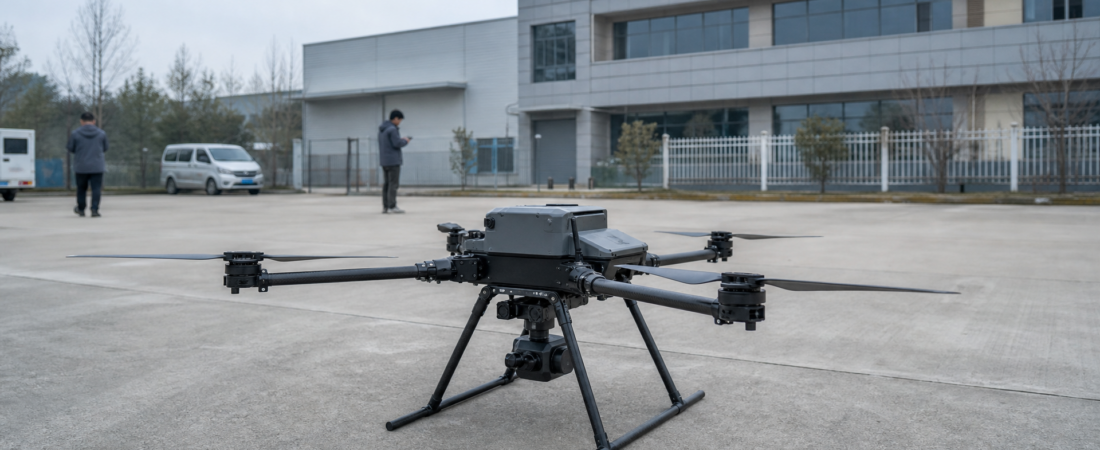
For the drone sector, the relevance is even more direct. Commercial unmanned systems are among the clearest examples of dual-use technology. Manufacturing capacity, component inventory, control software, mapping systems, and operator networks can all carry military value. If the revised mobilization framework broadens the state’s authority over that ecosystem, foreign stakeholders may need to revisit how they assess continuity, neutrality, and end-use risk in partnerships involving Chinese drone firms.
This also has supply-chain implications beyond the companies directly named in the reporting. A mobilization framework aimed at AI and drone assets could affect upstream and adjacent providers, including component suppliers, software partners, systems integrators, and logistics counterparties. The available source information does not establish that such spillovers will occur, but it does increase the salience of a question that many multinationals already face in Asia: how resilient is a commercial relationship if a state can redirect strategic technology assets during a crisis?
From a capital-flows perspective, the development may sharpen an issue that has become central to cross-border technology investing in Asia: legal exposure to national security intervention. The source does not provide evidence of investor withdrawals, regulatory action by foreign governments, or company-specific repricing. Still, a formal expansion of expropriation authority in dual-use sectors could influence how institutions think about governance risk, asset security, and partnership durability in China’s technology economy.
The law’s Asia relevance is broader than China alone. Across the region, governments are tightening the link between advanced technology and national security, particularly around AI, semiconductors, communications, and autonomous systems. China’s reported approach stands out because it appears to emphasize direct state authority over civilian assets in a contingency. That creates an important reference point for regional comparison, especially for companies trying to balance market access, supply-chain efficiency, and geopolitical resilience.
It is also important to separate signal from certainty. The available information supports the conclusion that Beijing has broadened its legal authority in this area. It does not support strong claims about how often the law will be used, which firms are most exposed, or what operational procedures would apply in practice. The strategic weight of the development lies in the existence of the framework and the sectors it reportedly reaches.
Investor Takeaway
For investors and corporate decision-makers, this development should be treated as a structural risk variable, not as proof of immediate disruption.
The most useful near-term question is whether the revised law remains a high-level legal instrument or is followed by more detailed implementing measures. Investors should monitor whether Chinese authorities publish further rules clarifying scope, triggers, reporting obligations, or operational procedures tied to mobilization authority.
A second watchpoint is company disclosure. If major Chinese AI or drone firms begin discussing mobilization-related risk in filings, statements, or partner communications, that would provide a more concrete basis for firm-level assessment than the current source material allows.
A third area to watch is behavior at the ecosystem level. Foreign customers, suppliers, and joint-venture partners may not exit relationships immediately, but they could tighten due diligence, contract language, inventory planning, end-use controls, or sourcing diversification. Those kinds of quiet adjustments often matter more than headline reactions.
A fourth variable is geopolitics. The practical significance of mobilization authority rises if cross-strait tensions intensify. If tensions remain contained, the law may function mainly as a strategic deterrent and a governance signal. If tensions escalate, legal provisions that once appeared remote could become far more relevant to operational planning.
The broad implication is that exposure to Chinese dual-use technology sectors can no longer be assessed only through product competitiveness or market growth. Legal access by the state in a crisis is also part of the equation. According to the available source information, China has moved to strengthen that access. For stakeholders across Asia’s AI and advanced-technology landscape, that is a development worth tracking closely.