Executive Summary
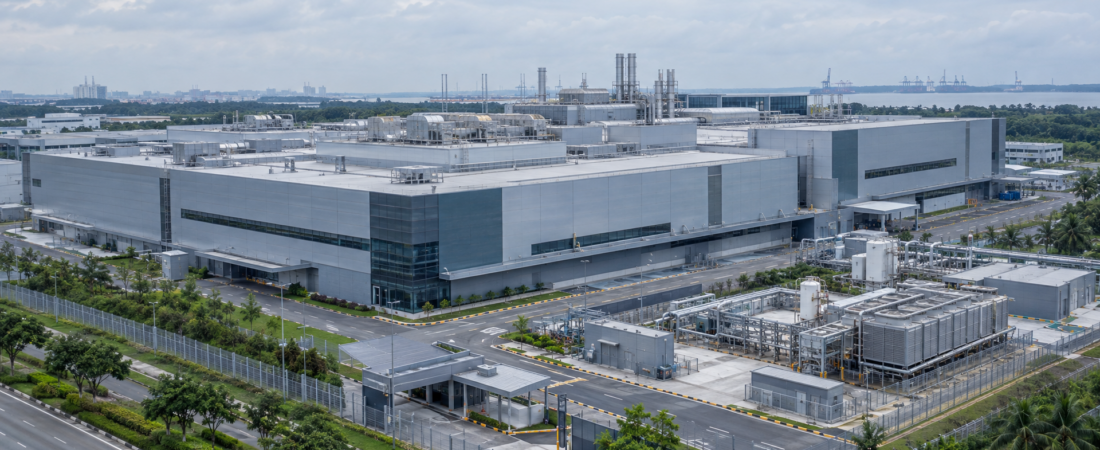
According to the available source information, GlobalFoundries’ Singapore fabs have moved above 90% capacity utilization as the company integrates Advanced Micro Foundry. The more consequential part of the report is not the utilization figure by itself, but the reason further silicon photonics expansion appears constrained: equipment lead times.
That shifts the story from a standard capacity update to a more strategic supply-chain signal. In semiconductor markets tied to AI infrastructure, the limiting factor is not always wafer demand or fab space. In some segments, it may increasingly be the availability and delivery timing of specialized tools needed to expand production.
For Singapore, this matters because the country remains one of Asia’s most important specialty manufacturing bases. A reported tool bottleneck at a Singapore site tied to silicon photonics suggests that future AI hardware constraints may emerge in less visible parts of the semiconductor stack, rather than only at the leading edge.
Watch the Short Brief
Watch this short visual briefing for the key strategic implications behind the story.
Key Developments
According to the source summary, GlobalFoundries’ Singapore fabs have exceeded 90% capacity utilization.
The reported increase comes as GlobalFoundries integrates Advanced Micro Foundry, a Singapore-based specialty foundry business that it acquired.
The same source indicates that further silicon photonics expansion in Singapore is being constrained by equipment lead times. Based on the information provided, the reported constraint is tied to tool availability rather than a stated lack of demand.
The available information does not identify the specific equipment categories involved, the vendors supplying those tools, the expected duration of the bottleneck, or the level of additional capital spending required to relieve it.
The development is Asia-relevant for two reasons. First, it centers on Singapore, a major semiconductor production hub with deep links into global supply chains. Second, it touches silicon photonics, an enabling technology that could become more important as AI systems demand faster and more power-efficient data movement.
Strategic Analysis
The most important takeaway is that this appears to be a constraint story, not simply a utilization story.
High fab utilization is not unusual in semiconductors. What matters more is what happens next when demand is strong and a manufacturer wants to add output. If the report is accurate, GlobalFoundries is not facing a straightforward decision to raise production by adding available tools on a predictable schedule. Instead, it may be facing a narrower supply-chain problem in which the equipment needed for additional photonics capacity takes longer to secure than the market would like.
That distinction matters because it changes where investors and industry observers should look for risk. In recent years, semiconductor bottleneck discussions have been dominated by advanced logic, EUV tools, advanced packaging, and high-bandwidth memory. Those remain critical. But the GlobalFoundries update suggests that the next layer of constraint may be forming in specialized manufacturing segments that support AI system scaling more indirectly.
Silicon photonics fits that pattern. In general industry terms, photonics is increasingly discussed as part of the answer to data-movement and power-efficiency challenges in large-scale computing and networking systems. If production capacity for those components becomes harder to expand because the necessary manufacturing tools arrive slowly, then the binding constraint moves upstream into a niche equipment chain that receives far less public attention than flagship leading-edge nodes.
This does not, on its own, prove a broad industry shortage in photonics equipment. The current information is too limited for that. The report does not say whether the bottleneck reflects a temporary issue specific to GlobalFoundries’ integration of Advanced Micro Foundry, a wider supplier backlog, or normal expansion friction in a specialized process segment. Even so, one strategic implication is clear: specialty semiconductors tied to AI infrastructure can face scaling limits that are very different from those in mainstream logic.
The Singapore angle is also important. Asia’s semiconductor position is not defined only by frontier logic manufacturing. It is also defined by dense clusters of specialty fabrication, mature-node production, packaging, testing, and component ecosystems that support the broader computing stack. A utilization level above 90% at a Singapore base, combined with reported difficulty expanding silicon photonics capacity quickly, suggests that competitive advantage may increasingly depend on who can secure specialized tools and ramp niche production fastest, not just who has physical fab footprint.
For regional policymakers and supply-chain planners, that points to a subtle but meaningful shift. In the AI era, chokepoints may not always emerge in the most publicized parts of the value chain. They can also appear in mature but strategically rising segments where equipment ecosystems are smaller, vendor concentration may be higher, and lead times can stretch when demand changes quickly.
There is also a capital-allocation angle. When utilization is already high, the instinctive conclusion is often that additional capacity investment will follow. But equipment-led bottlenecks can complicate that logic. A company may be willing to expand and may have the market rationale to do so, yet still be unable to accelerate output on a timeline that matches customer demand. In those cases, order timing, supplier relationships, and installation schedules become as important as headline capex intentions.
This is why the GlobalFoundries update is strategically useful even without more granular disclosure. It highlights how supply constraints can migrate from wafers and demand visibility toward tool availability in less-discussed process categories. For an Asia-focused semiconductor lens, that is a meaningful signal. It suggests that the next bottleneck in AI-adjacent hardware may emerge in specialized manufacturing infrastructure before it appears in end-market shipment data.
Investor Takeaway
Investors should read this development as an early indicator of where future semiconductor constraints could surface, rather than as proof of a sector-wide photonics shortage.
The confirmed part of the story is narrow but important: according to the report, GlobalFoundries’ Singapore fabs are running above 90% utilization, and silicon photonics expansion is being held back by equipment lead times. That alone is enough to raise the strategic importance of specialty tool supply in Singapore and, by extension, in Asia’s broader semiconductor ecosystem.
The key question now is whether this remains a company-specific issue or develops into a wider pattern. Investors should monitor whether GlobalFoundries provides additional clarity on the pace of Advanced Micro Foundry integration, the trajectory of Singapore utilization, and the timeline for relieving the reported photonics bottleneck.
A second watchpoint is whether other companies in adjacent segments begin describing similar issues. Comparable commentary from foundries, optical component makers, or semiconductor equipment suppliers would strengthen the case that this is a broader specialty-manufacturing constraint rather than a one-off operating challenge.
A third issue is timing. AI infrastructure demand often draws attention to chips, memory, and packaging first. But if enabling technologies such as silicon photonics cannot scale on schedule, the impact may show up later through slower infrastructure deployment, tighter component availability, or delayed customer qualification cycles. That remains a scenario, not a confirmed outcome, but it is the scenario that makes this report strategically relevant.
For TechPowerAsia readers, the broader lesson is straightforward: in Asia’s semiconductor landscape, the decisive bottleneck is not always the one attracting the most headlines. Singapore’s reported photonics equipment constraint is a reminder that in the AI era, specialized manufacturing tools can become critical gatekeepers of growth.