Executive Summary
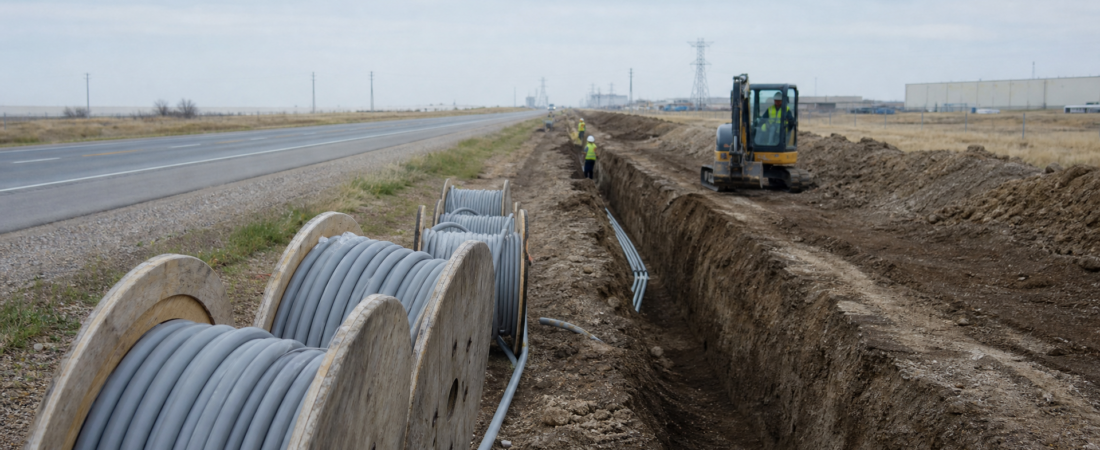
According to the available source information, digital infrastructure provider Zayo is partnering with Nvidia to build more than 8,000 miles of new long-haul fiber-optic routes in the United States to support rising AI-related data traffic between major computing hubs.
That matters because the AI infrastructure discussion is often dominated by semiconductors, power, and data center construction. The reported Zayo-Nvidia project points to another constraint that may become more important as AI systems scale: the physical networks that connect compute sites over long distances.
For TechPowerAsia readers, the immediate regional relevance is limited because the development is US-based. The broader strategic lesson is more important. If AI workloads increasingly span multiple campuses, cities, or regions, then fiber capacity and network architecture may become a more visible part of the AI supply chain, including in Asia.
Watch the Short Brief
Watch this short visual briefing for the key strategic implications behind the story.
Key Developments
According to the report, Zayo and Nvidia are working together on a US long-haul fiber expansion aimed at supporting AI-driven traffic growth. The core reported figure is more than 8,000 miles of new fiber routes.
The available information frames the project around connectivity between major computing hubs. That suggests the initiative is tied not simply to general internet demand, but to the movement of very large data volumes associated with AI infrastructure.
No pricing, investment value, contract terms, or build timeline were confirmed in the available source information. The report also does not provide enough support to make stronger claims about the commercial structure of the partnership beyond the fact of the collaboration itself.
At a minimum, the announcement indicates that AI capacity planning is reaching beyond chips and servers into long-haul communications infrastructure. Even with limited disclosed detail, that is strategically notable.
Strategic Analysis
The main significance of this development is not the headline mileage alone. It is what the partnership may indicate about the next layer of AI infrastructure pressure.
AI buildouts have been widely understood as a race for accelerators, advanced packaging, electric power, and capital expenditure. Those factors remain central. But very large AI systems also depend on moving data efficiently between facilities, whether for training, model synchronization, storage access, redundancy, or distributed inference architectures. As that inter-site traffic rises, the transport layer becomes harder to treat as a background utility.
This is where the Zayo-Nvidia partnership becomes analytically useful. According to the report, the buildout is designed to handle AI-driven traffic between major computing hubs. That implies a view of AI infrastructure as a networked system rather than a collection of isolated data centers. One strategic implication is that the value of compute capacity may depend increasingly on how well that compute can be interconnected.
In practical terms, the AI stack has a physical dimension that is easy to understate. Chips determine performance, and power determines whether systems can be deployed at scale. But fiber helps determine whether those systems can operate as part of a larger, distributed computing fabric. If the available network is insufficient, then adding more compute in separate locations may not translate cleanly into usable AI capacity.
This does not mean fiber has suddenly displaced semiconductors as the key AI bottleneck. The evidence here is too limited for that claim. But it does suggest that, in some deployments, networking constraints may become more important than markets have assumed.
The development also points to a broader supply-chain spillover effect. AI demand is already reshaping capital flows into semiconductors, memory, packaging, server hardware, cooling, and power infrastructure. Long-haul transport networks could be another beneficiary if hyperscale and AI-heavy operators increasingly require dedicated or expanded capacity between major sites. If that pattern strengthens, telecom and digital infrastructure assets may become more strategically relevant to AI buildouts than they have been in previous cloud cycles.
For Asia, the key point is not that the region is already following the same model. That would go beyond the available evidence. The more careful conclusion is that this US case may offer an early signal of the kinds of infrastructure dependencies Asian markets could also face as AI ecosystems scale.
That scenario is plausible for several reasons. Asian AI infrastructure is developing across multiple geographies with differing power availability, land costs, policy environments, and connectivity profiles. In that kind of environment, developers may not always be able to concentrate capacity in a single location. If AI workloads become more geographically distributed, reliable high-capacity interconnection could matter more for system performance, cost efficiency, and resilience.
This is especially relevant to TechPowerAsia’s supply-chain lens. The AI value chain is not only about who fabricates chips or assembles servers. It is also about which infrastructure layers become strategic as AI deployment matures. Fiber operators, transport network providers, and related equipment suppliers may not command the same visibility as GPU vendors, but they sit closer to the physical operating conditions of large-scale AI than many investors have historically modeled.
Still, caution is warranted. The report does not establish that long-haul fiber is becoming the dominant AI bottleneck, nor does it show how much of Nvidia’s broader infrastructure strategy this project represents. It also does not show whether this buildout reflects a one-off capacity need, a wider industry pattern, or a more durable shift in AI network design. Those are open questions.
A second reason for caution is architectural uncertainty. If future AI deployment becomes more localized, more efficient, or more concentrated within fewer very large campuses, the relative importance of long-haul connectivity could be lower than this announcement currently suggests. Conversely, if AI systems remain highly distributed across regions and facilities, transport infrastructure could move further up the strategic agenda.
The current evidence therefore supports a measured conclusion: fiber connectivity appears to be gaining importance as an enabling layer for large-scale AI operations, and the Zayo-Nvidia partnership may reflect that shift.
Investor Takeaway
For investors and industry strategists, this is best read as an infrastructure signal rather than a standalone company event.
First, the announcement reinforces the idea that AI capital intensity is spreading across adjacent sectors. Semiconductor leadership remains central, but the monetization of AI demand may continue to extend into power systems, cooling, networking, and transport infrastructure. The key analytical task is to identify which of those layers are becoming essential rather than merely supportive.
Second, investors should monitor whether similar arrangements begin to surface in Asian markets. The most important confirmation would not be rhetoric about AI-ready networks, but concrete signs that operators are expanding or reserving high-capacity intercity or cross-regional links to support AI workloads. If that emerges in markets such as Japan, South Korea, Taiwan, Singapore, or India, it would strengthen the case that fiber is becoming a structural AI enabler rather than a US-specific niche issue.
Third, this development highlights a timing question. Infrastructure buildouts are long-cycle assets, while AI demand projections remain volatile. If capacity is built too early relative to actual utilization, returns may lag expectations. If built too late, network constraints could slow the effective deployment of AI compute. That timing mismatch is likely to matter across multiple AI infrastructure categories, not just fiber.
Fourth, readers should separate confirmed fact from strategic interpretation. The confirmed core of the report is relatively narrow: Zayo and Nvidia are partnering on more than 8,000 miles of new long-haul fiber in the United States for AI-related traffic. The broader conclusion — that network infrastructure could become a more prominent AI bottleneck — is an analytical reading, not a directly confirmed outcome.
The bottom line is that this US project has limited immediate Asia market relevance, but it offers a useful reference case. As AI scales, the strategic map is widening. The question is no longer only who has the best chips or the most power, but also who can connect distributed compute efficiently enough for those assets to function as a coherent AI system.