Executive Summary
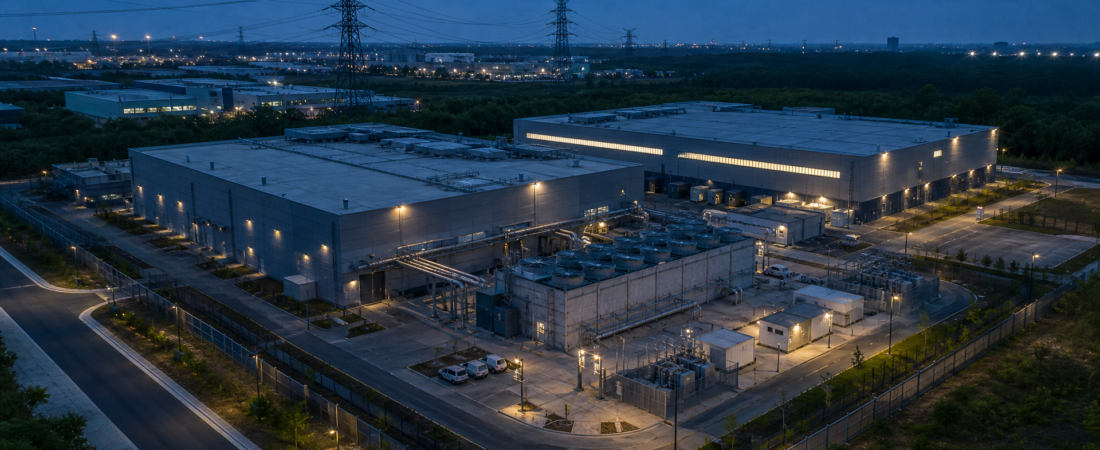
According to the available source information, Nvidia has partnered with Apollo, BlackRock, Blackstone, Brookfield, Goldman Sachs and KKR to establish independent AI compute infrastructure financing platforms aimed at mobilizing more than $500 billion of third-party capital. The stated focus is AI data centers and related infrastructure.
The announcement matters beyond the headline number. At a strategic level, it suggests a new financing model for AI buildouts: instead of relying only on technology company balance sheets, a larger share of compute infrastructure could be funded through institutional capital. That does not yet confirm a new asset class, but it does point to an effort to make AI compute capacity and supporting facilities more legible to infrastructure investors.
For Asia, the significance is indirect but material. If large pools of private capital become a more durable funding source for AI data centers, the effects could flow through semiconductor demand, memory ordering, advanced packaging, power equipment, and broader supply-chain planning across Taiwan, South Korea, Japan and other parts of Asia’s technology ecosystem. The key issue is not only how much capital is ultimately deployed, but where and under what financing terms.
Watch the Short Brief
Watch this short visual briefing for the key strategic implications behind the story.
Key Developments
Nvidia said on August 10, 2026 that it is partnering with six major financial institutions: Apollo, BlackRock, Blackstone, Brookfield, Goldman Sachs and KKR. According to the source summary, the goal is to establish independent compute financing platforms that could mobilize more than $500 billion of third-party capital for AI infrastructure.
The reported focus is AI data centers and related infrastructure. The available source information does not provide project-level allocations, binding capital commitments from each institution, or a detailed deployment timeline. It also does not specify how the planned financing vehicles will be structured, whether through debt, equity, hybrid instruments or other forms of infrastructure financing.
That distinction matters. The announcement clearly signals intent and strategic alignment between Nvidia and some of the world’s largest pools of private capital. But at this stage, the public information available here supports only a cautious reading: the framework is important, while the execution details remain to be seen.
Even so, the list of participants is notable. Apollo, BlackRock, Blackstone, Brookfield, Goldman Sachs and KKR collectively represent a broad cross-section of global private capital, spanning asset management, alternatives, infrastructure investing and investment banking. Their inclusion suggests that AI infrastructure financing is moving closer to mainstream institutional capital markets rather than remaining a niche vendor- or customer-led arrangement.
The geographic framing in the available materials is United States and global. No specific Asian projects, customer names or facility locations are identified in the information provided.
Strategic Analysis
The clearest strategic implication is that AI infrastructure financing may be entering a new phase of institutionalization. Nvidia’s announcement is not just about raising money for more servers or more data halls. It suggests an effort to create financing structures that can support AI compute buildouts at a scale that conventional corporate capital allocation may struggle to match on its own.
That has two important consequences.
First, it could broaden the investor base behind AI expansion. If compute-related infrastructure can be packaged in ways that large financial institutions understand and are willing to fund, then AI capacity growth may become less constrained by the internal capital budgets of a relatively small group of hyperscalers, cloud providers and enterprise buyers. That does not eliminate demand risk or technology obsolescence risk, but it could lower a practical funding bottleneck if these platforms move from memorandum-level announcements to active capital deployment.
Second, it may change how the market thinks about compute economics. Tech companies have typically been valued on software, services or semiconductor product cycles, while infrastructure investors have focused on long-duration assets with more predictable cash-flow characteristics. Nvidia’s reported initiative appears to sit between those worlds. The company is not merely selling chips into data centers; it is helping to shape a financing architecture around the infrastructure needed to deploy those chips at scale.
That is where the “asset class” discussion becomes relevant, but it should be treated as analysis rather than confirmed intent. The available source information does not establish that GPU compute has already become a recognized institutional asset class. What it does suggest is that major financial actors are willing to explore structures that treat AI infrastructure more like financeable infrastructure and less like a simple equipment purchase cycle.
Whether that model holds will depend on several unresolved questions. The most important is asset durability. AI accelerators and surrounding systems do not behave like roads, ports or transmission assets. Their economic value can shift quickly with new chip generations, software optimization, utilization rates and changes in model-training demand. If institutional capital is expected to finance AI compute at scale, the market will need workable assumptions around depreciation, refresh cycles, residual value and collateral quality.
A second issue is utilization visibility. Infrastructure finance tends to favor assets with durable demand and relatively clear revenue models. AI data center demand is strong today, but long-term cash-flow certainty is still developing. Investors will want to understand who is using the capacity, on what contractual basis, and how resilient those economics remain through technology transitions or cyclical slowdowns.
A third issue is cost of capital. If these platforms succeed, they could help spread AI buildout across a wider funding base. But the real strategic effect will depend on financing terms. If capital is available only at returns that assume very high utilization and rapid scaling, the model may support growth only in the strongest markets. If financing becomes efficient enough, it could expand the set of geographies and operators able to participate in the AI infrastructure buildout.
That is where Asia enters the picture.
For Asia-focused technology intelligence, the most important implication is not that the announcement names Asian projects. It does not. The important point is that changes in global AI capital formation tend to flow quickly into Asia’s semiconductor and hardware supply chains.
Taiwan remains central to advanced chip manufacturing. South Korea plays a leading role in memory, which is critical for AI systems. Japan remains important across semiconductor materials, tools and industrial components. If institutional capital materially accelerates AI data center deployment, suppliers across those ecosystems could see stronger and potentially more predictable demand signals. If financing stays concentrated in the United States, Asia may still benefit through exports and component demand. If the model later expands internationally, it could also affect where new compute clusters are built and which regional supply chains capture the next leg of spending.
The capital-flows dimension also matters. A financing architecture led by major U.S. financial institutions may reinforce U.S. leadership in AI infrastructure formation, especially if energy access, regulatory certainty and customer concentration make the U.S. market the easiest place to deploy capital first. For Asia, that raises a strategic question: whether regional markets can build equally competitive financing environments for AI infrastructure, or whether they risk supplying the hardware while capital formation and compute ownership remain concentrated elsewhere.
In that sense, Nvidia’s move may be as important for capital markets as for semiconductors. It links AI growth to infrastructure finance, and infrastructure finance tends to shape industrial geography over time.
Investor Takeaway
The immediate takeaway is not that $500 billion of AI infrastructure spending is now secured. According to the available source information, Nvidia has announced partnerships and a financing ambition at that scale. Investors should monitor whether those relationships convert into clearly structured, deployable capital vehicles.
Several indicators matter from here.
The first is structure. Market participants should watch how these platforms are actually financed and where the risk sits. Debt-led structures, equity-led structures and hybrid vehicles would carry very different implications for return expectations, resilience and expansion capacity.
The second is deployment visibility. Announced frameworks matter less than funded projects. Evidence of initial transactions, disclosed financing terms or identifiable data center buildouts would be a stronger signal that AI infrastructure finance is moving from concept to market practice.
The third is collateral logic. If institutional investors are backing AI compute infrastructure at scale, the market will need a convincing answer to how rapidly evolving hardware can support long-duration investment models. That question affects not only financing appetite, but also supplier order visibility across chips, memory, networking and data center equipment.
The fourth is geography. Investors focused on Asia should watch whether the capital ultimately reinforces U.S.-centric buildouts or begins to support a broader global distribution of AI capacity. That outcome would shape medium-term demand patterns across Asian semiconductor and industrial supply chains.
The broader conclusion is that Nvidia’s announcement may mark an early step toward a more financialized AI infrastructure model. If that model develops, it could alter how AI capacity is funded, who controls it, and how demand propagates through the global semiconductor ecosystem. For Asia, the implications are less about this specific announcement’s immediate local footprint and more about how a new capital architecture for AI could reshape supply chains, industrial positioning and cross-border technology investment over time.