Executive Summary
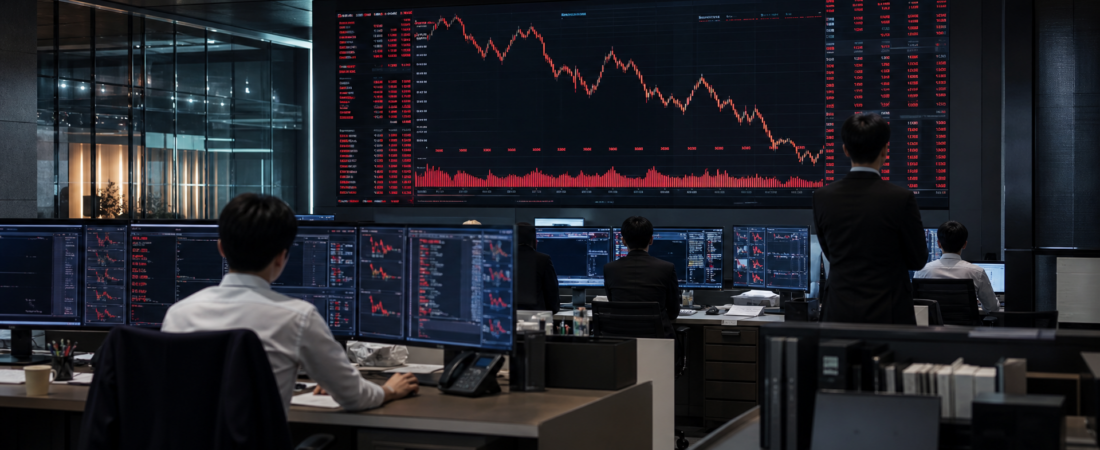
South Korea’s government moved to review market conditions after a sharp stock-market decline led by semiconductor shares, underscoring how closely the country’s market mood is tied to the chip sector. According to the available source information, Deputy Prime Minister Koo Yun Cheol convened an emergency market situation review meeting on July 29, 2026.
Officials reportedly linked the volatility to two external pressures: intensifying competition from China and funding concerns among US technology firms. They also said South Korea’s broader economic fundamentals remain solid.
For TechPowerAsia readers, the significance lies less in the meeting itself than in what the official framing reveals. Korean policymakers are publicly connecting local equity weakness to shifts in China’s semiconductor push and to financing conditions around the US technology ecosystem. That places South Korea’s leading chip companies, including Samsung Electronics and SK Hynix, at the center of a wider Asia-US technology and capital-markets story.
Watch the Short Brief
Watch this short visual briefing for the key strategic implications behind the story.
Key Developments
On July 29, 2026, South Korea’s Deputy Prime Minister Koo Yun Cheol convened an emergency market situation review meeting in response to a stock-market decline led by semiconductor shares, according to the source summary.
The reported official explanation centered on two factors. First, officials cited intensifying competition from China. Second, they pointed to funding concerns among US technology firms. The available source information does not provide further detail on the precise form of those funding concerns, nor does it specify which US companies or financing channels were involved.
Officials also maintained that South Korea’s economic fundamentals remain solid despite the market volatility.
The source links the development to South Korea’s semiconductor sector, where Samsung Electronics and SK Hynix are the most relevant listed companies named in the reporting context. Both are central to Korea’s position in regional and global chip supply chains.
At the same time, the available source information appears limited in several important respects. It does not specify the size of the market decline, detail any policy measures announced at the meeting, or identify concrete follow-up actions. That matters because the strategic meaning of the event depends not only on the emergency review itself, but also on whether it leads to additional policy or market-stabilization steps.
Strategic Analysis
The most important signal from this episode is that Seoul treated a semiconductor-led selloff as important enough to warrant high-level review. That does not by itself prove a broader economic shift, but it does suggest policymakers see chip-sector volatility as relevant to wider market confidence.
This is consistent with South Korea’s standing in Asia’s technology economy. The country’s equity market has substantial exposure to major semiconductor names, and its industrial profile is closely tied to chip production and exports. In that context, weakness in semiconductor shares can carry significance beyond a single industry group, even if the source does not establish the full scale of those effects.
The official reference to Chinese competition is especially notable. Over the past several years, competition with China has become a defining regional issue across semiconductors, advanced manufacturing, and technology supply chains. The source does not offer market-share data or product-level comparisons, so it would be too strong to draw precise conclusions about where Chinese competitors are gaining ground. Still, the fact that Korean officials cited Chinese pressure as a contributor to market volatility suggests that investors and policymakers are treating it as a present commercial and strategic issue rather than a distant possibility.
That matters for two reasons. First, it highlights that semiconductor competition in Asia is no longer just about technological leadership in the abstract. It is also about how quickly investors reassess future pricing power, profit expectations, and strategic positioning when Chinese capacity and capability appear to improve. Second, it suggests that market participants may be increasingly sensitive to any sign that China’s semiconductor progress could narrow perceived advantages held by established producers elsewhere in Asia.
The second factor cited by officials — funding concerns among US technology firms — is equally important, even though the source gives limited detail. South Korean chip companies are closely tied to global technology spending cycles, particularly where AI infrastructure and data-center investment shape memory and semiconductor demand expectations. If investors begin to question how comfortably major US technology firms can fund continued expansion, Korean semiconductor shares could come under pressure as markets revise assumptions about future demand.
That interpretation should remain cautious. The source does not say that US technology spending has already fallen, nor does it establish a direct change in orders for Korean suppliers. But the official framing suggests that financing conditions in the US technology sector are being watched in Seoul as a meaningful external variable for Korean markets.
Taken together, the two explanations cited by officials place South Korea at the intersection of two powerful cross-border forces. One is industrial competition from China. The other is capital-market confidence around the US technology sector. For a country whose leading listed technology companies sit within global semiconductor supply chains, both pressures can shape investor sentiment quickly.
This also has broader relevance for Asia technology intelligence. Semiconductor leadership in the region is increasingly being shaped not just by fabrication capability or product cycles, but by the interaction of industrial policy, capital access, and market psychology. A selloff in Seoul that officials connect to China competition and US financing concerns points to a more tightly coupled regional system. In such a system, events outside Korea can have immediate effects on valuations inside Korea.
Still, it is important not to overread a single government meeting. According to the available source information, no specific policy package was announced. The event therefore looks more like a signal of official concern and active monitoring than a confirmed policy turning point. Whether it becomes more consequential will depend on follow-through: additional government measures, sustained market weakness, or clearer evidence that the concerns cited by officials are affecting business conditions rather than only investor expectations.
Investor Takeaway
This development should be viewed as a meaningful policy and market signal, but not yet as proof of a structural break. The reported facts show that South Korea’s government responded quickly to a semiconductor-led market decline and publicly tied that volatility to Chinese competition and US technology-sector funding concerns. That combination alone makes the episode strategically relevant for investors tracking Asia’s semiconductor landscape.
The first question is whether this remains a short-lived sentiment event or develops into a more sustained repricing of Korean chip exposure. If semiconductor shares stabilize and no further measures are needed, the meeting may ultimately be remembered as a precautionary response during a volatile period. If weakness persists, the review could come to look like an early marker of broader concern around competitiveness and demand expectations.
The second question is whether Seoul follows the meeting with concrete action. Investors should monitor whether additional statements, stabilization measures, or industry-support initiatives emerge. The available source information does not indicate that such steps were announced, so any stronger conclusion would be premature.
The third question is how the two external variables identified by officials evolve. On China, the key issue is whether competitive pressure becomes more visible in areas that matter to Korea’s major chip producers. On the US side, the key issue is whether funding concerns remain a market narrative or begin to translate into more cautious technology spending.
For Samsung Electronics and SK Hynix, the immediate significance is less about a confirmed operational impact and more about market positioning. Both companies remain central to Korea’s semiconductor story, and their valuation sensitivity to global AI, memory, and competitive expectations is likely to remain high.
The broader takeaway is that South Korea’s semiconductor sector is being judged within a more interconnected regional and global framework. China’s industrial advance, US capital conditions, and local market confidence are increasingly part of the same conversation. Seoul’s emergency review does not settle that story, but it does show that policymakers are watching it closely.