Executive Summary
Thailand is stepping up its semiconductor ambitions under the “Made-in-Thailand Chip” initiative, according to the available source information. The reported framework aims to attract $80 billion in cumulative investment by 2050, with Infineon Technologies’ planned $1.4 billion complex serving as the clearest near-term anchor. On its face, that is a national industrial-policy signal rather than proof that Thailand has already secured a top-tier position in the regional chip hierarchy.
For Asia’s semiconductor landscape, the importance lies in what this move represents: another Southeast Asian economy trying to capture a larger share of supply-chain diversification as governments and chipmakers seek more resilience outside highly concentrated manufacturing footprints. The available information does not establish how far upstream Thailand can move or what policy tools will underpin the strategy. But it does suggest that Bangkok wants semiconductors to become a longer-duration national priority rather than a series of isolated investment wins.
That distinction matters for capital flows. In semiconductors, a single facility can be meaningful, but cluster formation usually depends on follow-on suppliers, engineering talent, infrastructure reliability, and sustained policy execution over many years. Thailand now appears to be signaling ambition on that timeline. The key question is whether the initiative develops into an investable ecosystem story or remains centered on a small number of marquee projects.
Watch the Short Brief
Watch this short visual briefing for the key strategic implications behind the story.
Key Developments
According to the source summary, Thailand is accelerating its National Semiconductor Strategy under the “Made-in-Thailand Chip” initiative. The headline target is $80 billion in cumulative semiconductor-related investment by 2050. That figure should be read as a long-horizon policy objective, not as committed capital today.
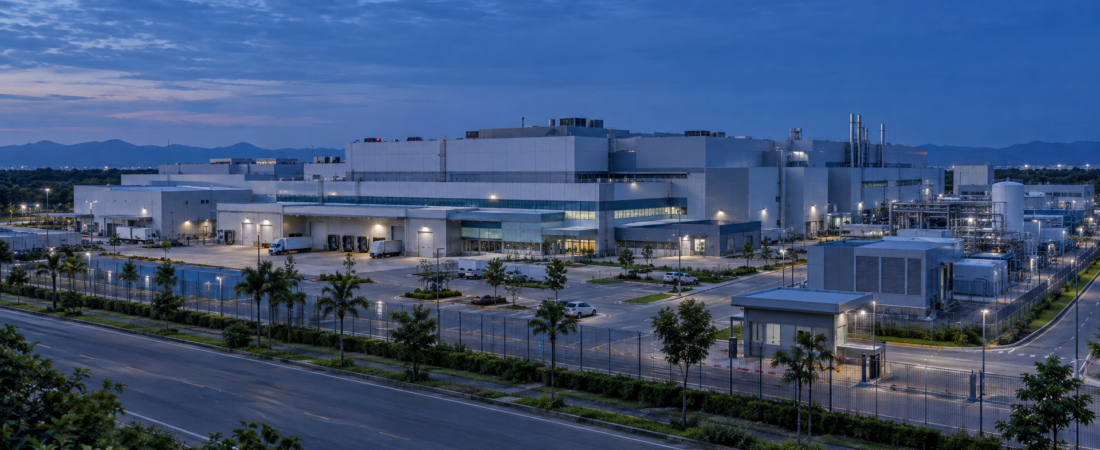
The most concrete reported element is Infineon Technologies’ new $1.4 billion complex, which the source frames as the strategy’s anchor investment. For TechPowerAsia readers, that is the clearest evidence that the initiative has at least one major industrial commitment attached to it. It also links Thailand’s ambitions to a global chipmaker rather than a purely domestic plan.
Beyond those points, the available source information is limited on the policy architecture. It does not clearly establish the exact incentive framework, intermediate milestones, or the full set of market segments Thailand intends to prioritize. That lack of detail does not negate the significance of the announcement, but it does affect how investors and industry observers should interpret it: as an important strategic signal, with execution still to be tested.
The Asia relevance is straightforward. Southeast Asia has become a key theater in semiconductor supply-chain diversification, especially for companies seeking redundancy across manufacturing locations. Thailand’s push places it more directly into that regional contest for capital, technology partnerships, and ecosystem development.
Strategic Analysis
Thailand’s move is best understood as an industrial positioning effort at a time when semiconductor supply chains are being rebalanced across Asia. For several years, the region has benefited from a structural search for manufacturing resilience, not only because of cost considerations but also because geopolitical risk has raised the value of geographic diversification. A formal national strategy matters in that context because semiconductor investment decisions often extend across decades, not election cycles.
The reported $80 billion target serves less as a near-term forecast than as a statement of policy intent. Large semiconductor ecosystems are rarely built through a single announcement. They usually emerge through a sequence of investments in facilities, suppliers, workforce pipelines, utilities, logistics, and applied research. If Thailand can align those elements, the country could strengthen its position in parts of the chip value chain that fit its broader electronics manufacturing base. If it cannot, the strategy may be remembered more for ambition than for industrial transformation.
Infineon’s role is therefore important beyond the headline number. Anchor investments can have an outsized signaling effect. They can validate a location for future suppliers, encourage local capability building, and give governments a reference point for additional policy design. In Southeast Asia, where competition for semiconductor capital is increasingly intense, a credible anchor tenant can be the difference between a policy concept and a cluster that begins to take shape.
Still, one project does not by itself establish a semiconductor hub. The harder phase comes after the announcement cycle: attracting adjacent manufacturers, improving engineering depth, shortening permitting timelines, ensuring power and water reliability, and building a pipeline of technical labor that can support expansion. Semiconductor strategies often look compelling at launch but face a long execution gap before they alter regional market structure in a durable way.
That is why the available information should be read cautiously. The source summary supports the existence of a national initiative, a large long-term investment target, and a significant Infineon commitment. It does not, however, fully define what kind of semiconductor specialization Thailand is likely to dominate, how rapidly its capabilities could deepen, or whether the country is positioned to move meaningfully into more advanced parts of the manufacturing chain. Those questions remain open.
From a regional perspective, Thailand’s bid also highlights a broader shift in Southeast Asia’s industrial competition. The region is no longer being viewed only as a lower-cost manufacturing alternative. It is increasingly competing on resilience, ecosystem readiness, and strategic alignment with multinational supply-chain redesign. That raises the bar for governments. Incentives alone are rarely enough. Investors will want to see whether Thailand can translate a headline strategy into institutional follow-through, including education, infrastructure, and supplier-network development.
There is also an important capital-allocation angle. Semiconductor investment is highly cyclical at the company level but structurally long-term at the national level. Governments pursuing these strategies are effectively betting that future demand in areas such as electrification, industrial automation, connectivity, and AI-adjacent hardware will justify years of enabling investment before full ecosystem benefits appear. Thailand’s initiative fits that pattern. The reported plan may indicate confidence that semiconductor-related manufacturing can become a larger pillar of national industrial growth over time.
For Asia’s technology landscape, the broader takeaway is that second-tier semiconductor destinations are trying to become more central to the next phase of supply-chain design. Whether they succeed depends less on rhetoric than on compounding execution. Thailand has now put a target and an anchor asset on the table. The next phase is ecosystem proof.
Investor Takeaway
Investors and strategic operators should view Thailand’s semiconductor push as a developing industrial story rather than a completed market shift. The most solid reported facts are the acceleration of a national strategy under the Made-in-Thailand Chip initiative, the $80 billion cumulative investment target through 2050, and Infineon’s $1.4 billion complex as the anchor project. Everything beyond that depends on how execution unfolds.
The first issue to monitor is follow-on investment. A national semiconductor strategy becomes more credible when additional chipmakers, materials suppliers, tool vendors, and specialist service providers begin making location decisions around the anchor project. Without that second wave, Thailand’s semiconductor narrative could remain narrow.
The second issue is policy specificity. The available source information signals ambition, but investors will need more clarity on incentives, implementation timelines, workforce programs, and infrastructure commitments. Semiconductor manufacturing is unusually sensitive to reliability in utilities, logistics, and permitting. A well-branded strategy matters less than the state’s ability to reduce friction for long-cycle industrial investment.
The third issue is regional positioning. Thailand does not need to replicate every segment of Asia’s semiconductor chain to become more relevant. A realistic path may involve strengthening specific parts of the ecosystem where existing manufacturing depth, industrial demand, or supply-chain adjacency provide an advantage. The key question is whether policy execution can turn those advantages into durable specialization.
For now, the signal is constructive but early. Thailand has elevated semiconductors into a clearer national priority and secured a meaningful anchor investment from a major international player. That is enough to justify closer attention from companies, suppliers, and investors focused on Asia’s next layer of semiconductor capacity. It is not yet enough to conclude that Thailand has locked in a leading regional position. The next set of announcements will matter more than the headline target alone.