Executive Summary
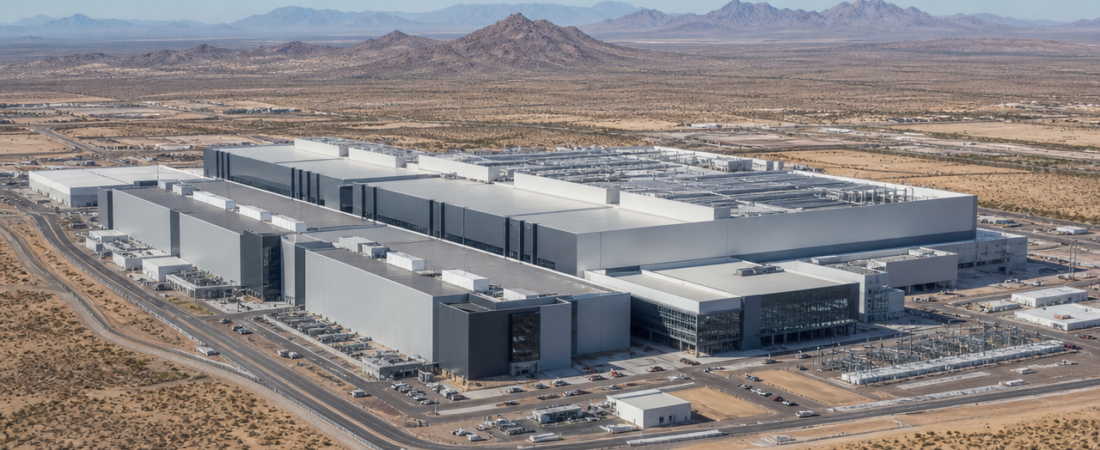
The U.S. Department of Commerce and the White House have announced that TSMC will invest an additional $100 billion in Arizona, bringing the company’s total announced U.S. commitment to $265 billion. According to the available source information, the expansion adds four advanced semiconductor manufacturing facilities and brings TSMC’s planned U.S. footprint to 12 leading-edge logic and packaging facilities.
The headline number is important, but the larger significance is strategic. TSMC has long stood at the center of the global semiconductor system, with most of its most important manufacturing capacity concentrated in Taiwan. A U.S. buildout at this scale may indicate more than incremental capacity growth. It suggests a longer-term shift in where advanced chip production and packaging could be located, how governments are trying to shape that outcome, and how customers may think about supply assurance in the AI era.
For Asia-focused technology intelligence, the key issue is not only what this means for the United States. It is also what it may mean for Taiwan’s long-term strategic position, for regional supply-chain concentration, and for the balance between resilience and dependence in the world’s most important chipmaking network.
Watch the Short Brief
Watch this short visual briefing for the key strategic implications behind the story.
Key Developments
The reported facts are straightforward. According to the source announcement, TSMC is adding $100 billion to its Arizona investment plans, lifting its total U.S. commitment to $265 billion.
The same source information says the expansion will add four advanced semiconductor manufacturing facilities. That would bring TSMC’s total planned U.S. footprint to 12 leading-edge logic and packaging facilities.
Even without more detail on the exact mix of fabs and packaging sites, the announcement matters because it combines two of the industry’s most strategically sensitive layers: leading-edge logic production and packaging capacity. In today’s semiconductor market, both are central to AI hardware supply chains.
The announcement also reinforces a broader pattern already visible across the industry. Governments are no longer treating chip production as just another manufacturing sector. Advanced semiconductors are increasingly viewed as strategic infrastructure tied to AI competitiveness, national security, and economic resilience.
Strategic Analysis
This development is best read as a geographic diversification story with geopolitical consequences.
For years, the semiconductor industry has depended heavily on Taiwan for the production of the most advanced chips. That concentration created enormous efficiency and scale, but it also left the global technology system exposed to a single geographic chokepoint. TSMC’s Arizona expansion does not eliminate that dependence, but it may reduce it at the margin by building a more substantial manufacturing base outside Taiwan.
That matters because advanced semiconductors are no longer only inputs for smartphones and consumer electronics. They are foundational to AI infrastructure, cloud computing, defense systems, and industrial automation. As the strategic value of advanced chips has risen, so has the cost of geographic concentration.
One implication is that TSMC’s U.S. buildout may increasingly be viewed not just as foreign direct investment, but as part of a broader redistribution of strategic capacity. The United States appears intent on anchoring more advanced chip production domestically. TSMC, as the world’s most important contract chipmaker, sits at the center of that effort whether the driver is customer demand, political pressure, long-term risk management, or some combination of all three.
The packaging angle is especially important. In semiconductor discussions, public attention often centers on wafer fabrication, but advanced packaging has become a critical bottleneck in the AI hardware stack. The performance and integration requirements of modern AI accelerators mean that packaging is not a secondary step. It is part of the competitive frontier. If a growing share of packaging capability is built alongside logic manufacturing in the United States, that would represent a more structurally significant shift than fab announcements alone.
That does not mean the strategic transition is complete. Announced investment is not the same as fully operational capacity, and facility counts do not by themselves reveal process mix, output volume, timing, or customer allocation. But the scale of the commitment suggests that the industry is moving beyond symbolic onshoring. At minimum, this looks like a serious attempt to create a durable U.S. base for advanced semiconductor production.
For Taiwan, the implications are more complex.
On one side, a larger U.S. footprint could strengthen TSMC’s political and commercial position with Washington and with major global customers. That may reinforce the company’s role as an indispensable supplier within the broader Western technology ecosystem. From that perspective, overseas expansion can be seen as a way to deepen strategic alignment without displacing Taiwan’s central role overnight.
On the other side, a sustained shift of advanced capacity abroad could gradually change the way policymakers and markets think about Taiwan’s strategic leverage. For years, one line of analysis held that the world’s reliance on Taiwan’s chipmaking base raised the economic cost of any disruption. If advanced capacity becomes more geographically distributed over time, that dynamic may weaken at the margin. This would not erase Taiwan’s importance, but it could alter the balance between concentration risk and strategic dependence.
That tension is likely to become more important as governments and customers pursue resilience. The question is no longer whether diversification will happen. The question is how far it goes, how quickly it becomes operational, and whether it changes the real center of gravity of advanced manufacturing or simply adds a secondary node around a still Taiwan-led system.
For the broader Asia technology landscape, the message is clear: semiconductor leadership is no longer measured only by process technology. It is also measured by geography, political alignment, supply-chain optionality, and the ability to secure production close to end demand and strategic customers. TSMC’s Arizona commitment sits at the intersection of all of these trends.
Investor Takeaway
Investors and strategic decision-makers should treat this announcement as a major signal, while remaining disciplined about the difference between committed capital and delivered capacity.
The first issue to watch is execution. Semiconductor manufacturing projects are large, expensive, and operationally demanding. The announced $265 billion commitment is significant, but the market impact will depend on construction progress, equipment installation, workforce readiness, and production ramp. Investors should monitor whether reported investment translates into usable leading-edge and packaging output on commercially relevant timelines.
The second issue is whether this expansion changes customer sourcing behavior. A larger Arizona base could eventually offer major advanced-chip customers more geographic diversification. But that outcome depends on qualification, scale, and economics. The key question is whether U.S.-based production becomes a meaningful supply option for advanced volumes or remains more limited relative to TSMC’s Taiwan operations.
The third issue is what this means for Taiwan’s relative role in the global semiconductor system. The expansion may strengthen TSMC as a company while still creating longer-term questions for Taiwan as a manufacturing center. Investors should watch whether future leading-edge expansion appears additive to Taiwan’s base or increasingly redistributive across geographies.
The fourth issue is policy durability. Even though the available source information does not spell out the detailed economics behind this commitment, semiconductor investment at this scale rarely exists in a purely commercial vacuum. Future disclosures around incentives, permitting, and policy support could shape both returns and strategic interpretation.
The fifth issue is packaging. In the AI era, packaging capacity can be just as strategically important as logic capacity. Investors should pay close attention to how much of the announced U.S. footprint translates into meaningful advanced packaging capability, because that will be one of the clearest indicators of whether supply-chain resilience is becoming operational rather than rhetorical.
The deeper takeaway is that TSMC’s Arizona expansion should be read as a capital-allocation event with geopolitical meaning. It reflects a world in which advanced semiconductors are being positioned as strategic assets, not just industrial products. For Asia, and especially for Taiwan, that makes this announcement more than a U.S. manufacturing story. It is part of a larger reordering of where technological power is built, secured, and negotiated.