Executive Summary
TSMC reported September 2026 consolidated revenue of NT$511.86 billion, bringing its third-quarter 2026 revenue to a record NT$1.49 trillion, or about $46.7 billion, according to the available source information. The reported figure represents a 50% year-over-year increase, with the source attributing the growth to sustained demand for AI accelerators.
That makes the quarter important well beyond a single company’s topline result. As a leading advanced semiconductor foundry based in Taiwan, TSMC sits close to the center of the global AI hardware buildout. Strong revenue at this point in the supply chain may indicate that demand for leading-edge compute remains elevated and that customer spending on advanced chips is still converting into manufactured output.
At the same time, the available information does not include a breakdown by customer, process node, or end market. That limits how precisely investors can separate AI-specific demand from other contributors such as broader advanced-chip demand. Even so, one strategic conclusion stands out: as AI infrastructure spending grows, Taiwan’s role in the global semiconductor system becomes even more consequential.
Watch the Short Brief
Watch this short visual briefing for the key strategic implications behind the story.
Key Developments
TSMC reported NT$511.86 billion in consolidated revenue for September 2026, according to the source summary. That lifted third-quarter 2026 revenue to NT$1.49 trillion, described in the source as a record quarterly result.
The source says the quarter’s revenue rose 50% from a year earlier and links that performance to continued AI accelerator demand. On its face, that is a notable data point for the semiconductor sector, because foundry revenue is tied to actual wafer production rather than only end-market sentiment.
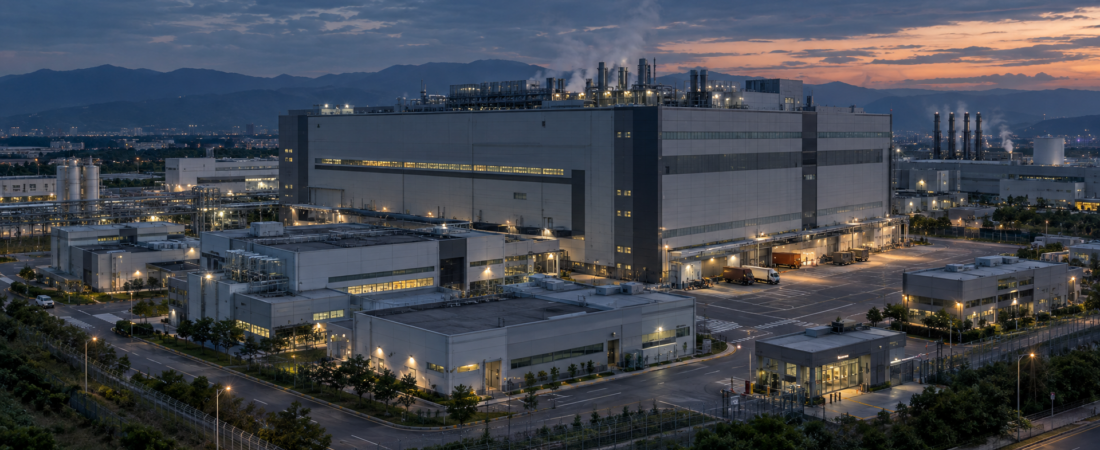
The development is especially relevant in an Asia context. TSMC’s advanced manufacturing base remains concentrated in Taiwan, making the island a critical node in the supply chain for high-performance chips used across AI infrastructure and other advanced electronics categories.
What the reported information does not provide is equally important. There is no segment-level detail showing how much of the quarter came from AI accelerators versus smartphones, PCs, or other end markets. There is also no customer-level breakdown and no forward guidance included in the source package. That means the headline result is clear, but the internal composition of the growth remains less so.
Strategic Analysis
The most important implication of TSMC’s quarter is not simply that revenue was strong. It is that the strength appeared at a strategic chokepoint in the semiconductor value chain.
AI enthusiasm often shows up first in product launches, capital expenditure plans, or company commentary. TSMC’s revenue matters for a different reason: it reflects manufacturing activity already underway. In that sense, the reported quarter may be read as evidence that demand for advanced compute has remained firm enough to sustain high levels of foundry output.
That does not mean TSMC should be treated as a perfect proxy for the entire AI market. The available source information is too limited for that. But it does suggest that the AI buildout is still large enough to materially support one of the world’s most important chip manufacturers. For investors, that is a more grounded signal than broad thematic narratives alone.
One implication is that the current AI cycle still appears to be supply-chain deep rather than purely market-facing. When revenue strength shows up at a leading foundry, it suggests that spending is not only concentrated in software expectations or data-center announcements. It is also flowing into the physical production layer of the technology stack.
A second implication concerns Asia’s strategic leverage. TSMC’s role has long made Taiwan indispensable to global electronics. In the AI era, that importance may be increasing further. If more leading-edge demand is being driven by AI accelerators, then a larger share of global compute expansion is effectively passing through a manufacturing ecosystem centered on Taiwan.
That concentration creates both strength and risk. It strengthens Taiwan’s strategic relevance within the global semiconductor economy. But it also leaves customers, investors, and governments exposed to a narrow manufacturing geography at a time when AI is becoming more central to industrial policy, digital infrastructure, and national competitiveness.
This is where the quarter carries significance beyond revenue momentum. Every record result at a concentrated manufacturing node reinforces a structural reality: the world is still scaling AI capacity faster than it is diversifying the most advanced production base behind that capacity. Even where overseas expansion exists, Taiwan remains the reference point for leading-edge semiconductor manufacturing.
There is also a capital-allocation angle. If the source attribution is directionally accurate and AI accelerator demand is the main driver, then the quarter suggests that major buyers across the AI hardware chain are still willing to commit meaningful spend despite ongoing concerns about cycle durability, valuation, and eventual utilization rates. That does not settle the debate over whether AI capex will normalize later. It does indicate that, for now, upstream demand has remained strong enough to support very large production volumes.
Still, caution is warranted in reading too much into a single quarter. Without detail on product mix, node contribution, or customer concentration, investors cannot yet determine whether the growth reflects broad and durable end demand, temporary order timing, or a mix of AI and non-AI strength. A foundry quarter can be strategically informative without answering every demand-quality question.
That uncertainty matters because semiconductor cycles can look strongest at the point when visibility is highest and capacity is most constrained. If AI-related orders continue to dominate advanced-node demand, TSMC’s position may remain exceptionally strong. If some of the current strength reflects pull-forward activity or inventory positioning, later quarters could look less dramatic even if the long-term AI trend remains intact.
In other words, the reported quarter supports the view that AI chip demand is still robust. It does not, by itself, prove that the current pace will continue uninterrupted or that all adjacent parts of the semiconductor market are participating equally.
Investor Takeaway
For TechPowerAsia readers, TSMC’s third-quarter result is best understood as a high-value strategic signal from the heart of Asia’s semiconductor system.
First, the quarter suggests that AI-linked demand remains strong enough to support record revenue at one of the industry’s most important production nodes. That does not resolve every question about end-market durability, but it does indicate that AI infrastructure spending is still showing up in the physical manufacturing layer.
Second, investors should keep the geographic lens in focus. As advanced semiconductor demand rises, Taiwan’s centrality to the global AI stack becomes more pronounced. That raises the strategic premium on supply-chain resilience, overseas capacity diversification, and geopolitical risk monitoring.
Third, the next key question is composition. Investors should monitor whether future disclosures provide more clarity on the mix between AI accelerators and other advanced-chip categories. They should also watch for any indication of changes in capacity utilization, customer ordering patterns, or demand timing.
Finally, the broader takeaway is that strong AI narratives are more credible when they are matched by upstream production data. According to the available source information, TSMC’s quarter adds weight to the argument that the AI hardware cycle is still expanding. But the most important follow-up question is not whether demand has been strong. It is whether that strength proves broad, durable, and diversified enough to sustain the next phase of semiconductor and AI infrastructure investment across Asia.