Executive Summary
According to the source report, the United States and China are preparing for high-level bilateral talks focused on artificial intelligence safety. That matters less because of any confirmed policy outcome and more because of what the reported dialogue may represent: a limited effort to separate AI risk management from a broader technology relationship that remains increasingly adversarial.
The available information suggests both governments are trying to balance two objectives that often pull in opposite directions. On one side is the competition for technological leadership in frontier AI. On the other is the need for at least some guardrails around advanced systems that could create shared risks if deployed without restraint.
For Asia’s technology ecosystem, the significance is indirect but important. US-China AI governance, even when narrowly defined, can shape regulatory expectations for AI infrastructure, semiconductors, cross-border research, and supply-chain planning across the region. If a safety dialogue gains continuity, it may indicate that some categories of frontier AI risk are being treated as distinct from commercial and geopolitical competition. If the channel proves shallow or collapses quickly, the stronger message may be that AI safety remains subordinate to the wider strategic contest.
At this stage, investors and policy watchers should treat the reported talks as an early signal, not as evidence of broader détente. The key question is whether this becomes a durable mechanism for technical risk reduction or remains a symbolic gesture inside a worsening rivalry.
Watch the Short Brief
Watch this short visual briefing for the key strategic implications behind the story.
Key Developments
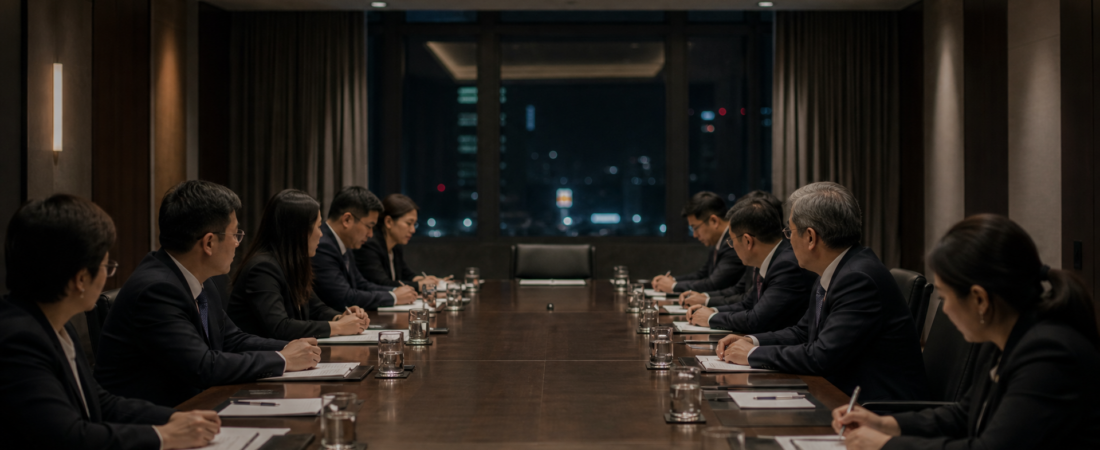
According to the source report, Washington and Beijing are preparing for high-level bilateral talks specifically centered on AI safety. The report frames the development as notable because it is taking place even as competition between the two countries continues to intensify across strategic technology domains.
The core tension described in the report is straightforward: both countries are pursuing AI leadership while also confronting the possibility that frontier AI systems may introduce risks neither side can fully manage alone. In that sense, the reported talks appear to be less about reducing competition and more about exploring whether a narrow area of cooperation can coexist with a broader contest for technological advantage.
The available source information does not provide detailed confirmation on the format of the talks, their timing, the officials or institutions involved, or the specific scope of “AI safety” under discussion. It therefore remains unclear whether the dialogue would focus on frontier model control, governance principles, military uses of AI, or another subset of risk management.
No related companies are identified in the source materials. That absence is also meaningful: the development, as currently reported, should be read primarily as a state-level diplomatic signal rather than a company-driven initiative.
In broader context, the talks would sit against a strained US-China technology backdrop that includes export controls, semiconductor restrictions, and other disputes over technology access and strategic dependence. Those issues are not presented in the available source information as part of the talks themselves, but they form the policy environment in which any AI safety engagement would have to operate.
Strategic Analysis
The strategic importance of this development lies in its narrowness. A limited AI safety dialogue between the United States and China would not, by itself, suggest a thaw in technology competition. It could instead indicate that both sides see at least one category of AI risk as too consequential to leave entirely to unilateral action.
That distinction matters for Asia. The region sits at the center of semiconductor manufacturing, AI hardware deployment, cloud infrastructure expansion, and the capital flows that support them. When the two largest AI powers establish even a small channel for technical dialogue, it can influence how governments, suppliers, and investors think about future policy fragmentation. A functioning safety track may imply that not every part of the AI stack will be governed through pure zero-sum logic.
One implication is that AI policy may continue to split into two tracks. The first is strategic competition: controls on advanced technology, tighter security reviews, and efforts to reduce dependence in key hardware and software areas. The second is risk management: narrow discussions on failure modes, escalation risks, and governance standards for increasingly capable systems. If the reported talks move forward, they may be an early example of that separation.
For Asia-based technology players, that would be a more complex environment than simple decoupling. Companies and investors would still need to navigate export restrictions, localization pressures, and rival national technology ecosystems. But they would also need to watch whether AI safety becomes an area where limited convergence is still possible, particularly in relation to model testing, reporting norms, or other forms of non-commercial coordination.
That said, the durability question is central. Diplomatic channels like this are often fragile when they exist inside a relationship defined by mistrust. A dispute elsewhere in the technology relationship could easily overwhelm a safety-focused agenda. Semiconductor measures, trade friction, or a geopolitical shock unrelated to AI could narrow the political space for continued engagement.
The lack of detail in the currently available information reinforces that caution. There is no confirmed evidence yet of a standing mechanism, a formal working group, or an agreed framework that would make the talks more resilient. Without institutional depth, bilateral engagement on AI safety may remain vulnerable to interruption.
There is also a deeper strategic ambiguity. Cooperation on AI safety does not necessarily mean convergence on AI governance. Washington and Beijing may share an interest in preventing extreme failure scenarios while still holding sharply different views on openness, state control, military application, and the balance between innovation and regulation. As a result, even sustained dialogue might produce only minimal common ground.
Still, minimal common ground can matter. In frontier technologies, especially those with systemic or cross-border risk, communication itself can reduce uncertainty. Even if no meaningful alignment emerges on commercial policy or technology access, a narrow channel for discussing AI safety could help establish baseline expectations about how each side interprets emerging risks.
From an Asia technology-intelligence perspective, the broader significance is less about the immediate content of the talks than about the model they may create. If confirmed and sustained, they would suggest that contested technologies can be governed through selective engagement rather than through total isolation. That would not reverse rivalry, but it could complicate the assumption that every technology issue between the two powers must be treated exclusively as a security contest.
Investor Takeaway
Investors should treat the reported US-China AI safety talks as a signal to monitor, not as a turning point. The most important near-term issue is whether the dialogue acquires structure. If future reporting shows repeat meetings, named technical participants, or some form of joint framework, that would suggest the talks have more than symbolic value. If not, the initiative may remain diplomatically useful but strategically thin.
For Asia-focused investors, the relevant exposure is not a direct company call tied to this report but a policy watch across several areas. Semiconductor supply chains remain sensitive because any shift in the tone of US-China AI engagement can affect expectations around controls, compliance, and long-term infrastructure planning. AI infrastructure operators, cloud platforms, and data center investors should also monitor whether safety language begins appearing alongside broader discussions of AI deployment standards.
A second area to watch is governance spillover. If the United States and China maintain even limited contact on AI safety, other Asian governments may face pressure to refine their own positions on frontier AI oversight, model evaluation, or international coordination. That could gradually shape regional policy frameworks, especially in markets balancing security alignment with commercial dependence on both ecosystems.
A third issue is what would weaken the signal. Cancellation, prolonged silence after the reported preparations, or a visible escalation in the wider technology confrontation would all suggest that AI safety is not insulated from rivalry. In that scenario, the market takeaway would be that risk-management cooperation has little independent force when strategic tensions rise.
The prudent conclusion is narrow. According to the available source information, the United States and China are preparing talks on AI safety despite a worsening technology rivalry. That does not indicate broader reconciliation. It may, however, point to an emerging logic in which selective cooperation on extreme technological risk survives alongside deep competition in chips, infrastructure, and strategic industry policy. For Asia’s technology landscape, that distinction is worth watching closely.