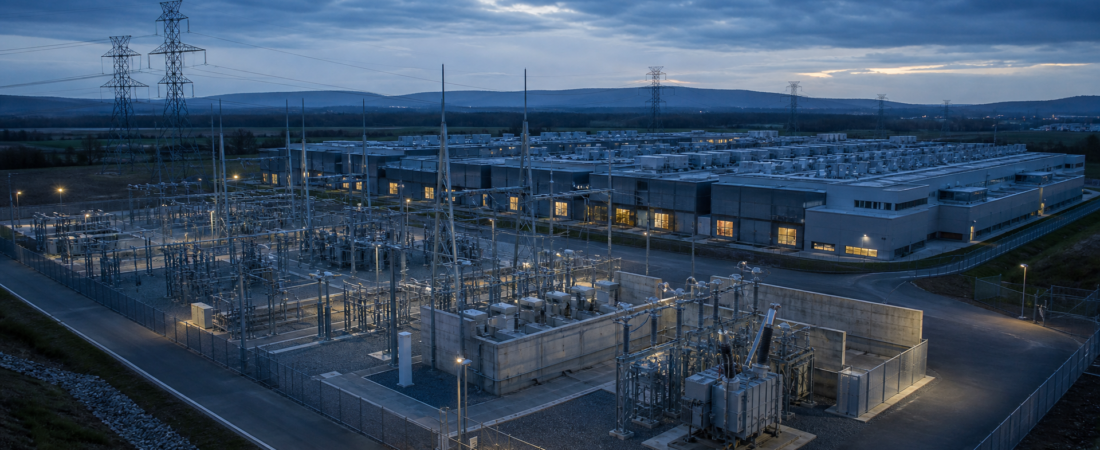
Executive Summary
According to the available source information, US President Donald Trump has issued an emergency executive order barring foreign-produced power equipment from countries such as China. The report’s immediate focus is the US battery energy storage system market, where the order is described as creating a severe supply chain challenge.
That is already significant on its own. Battery storage sits close to the center of grid modernization, renewable integration, and industrial power management in the US. If critical equipment becomes harder to source, project timelines, costs, and deployment planning could all come under pressure.
The broader strategic question for TechPowerAsia readers is whether this kind of policy action may expose another layer of infrastructure dependency that sits adjacent to the AI buildout. The source does not present AI data centers as the primary story. But it does point to a wider issue: advanced computing expansion ultimately depends not only on chips and servers, but also on the electrical systems that bring large-scale capacity online. If restrictions on power equipment tighten supply across storage and grid projects, the effect could extend beyond energy markets and into the physical foundations of digital infrastructure.
For Asia, the development reinforces a familiar pattern in US-China technology competition. Trade and security measures aimed at reducing dependence on China can shift risk from one part of the stack to another. In this case, the pressure point may be power hardware rather than semiconductors.
Watch the Short Brief
Watch this short visual briefing for the key strategic implications behind the story.
Key Developments
The reported policy move is an emergency executive order that bans foreign-produced power equipment from countries like China. Based on the available source information, the most immediate market impact is expected in US battery energy storage systems, or BESS, where the report frames the situation as a serious supply chain problem.
That framing matters. The source does not describe the order primarily as a data center policy or an AI policy. It describes a supply chain dilemma for energy storage. Any broader infrastructure implications therefore need to be treated as analysis rather than as a confirmed direct outcome reported by the source.
The available information also leaves several implementation questions unresolved. It does not clearly establish the full product scope, the detailed compliance path, the treatment of existing contracts, or the extent to which exemptions may be available. Those details will matter because the commercial impact of a restriction often depends less on the headline policy than on how narrowly or broadly it is applied in practice.
Even with those uncertainties, the reported measure adds to a larger pattern of US efforts to reduce strategic dependence on Chinese industrial supply chains. In semiconductors, that has largely centered on export controls and domestic subsidy frameworks. In power infrastructure, the same logic can produce a different kind of friction: restrictions arrive before replacement capacity is fully established.
Strategic Analysis
The most important insight here is that infrastructure competition in the AI era is not only about compute. It is also about power.
Public discussion of US-China technology rivalry still tends to focus on chips, manufacturing equipment, and AI accelerators. That focus is justified, but incomplete. Large-scale compute requires a chain of physical systems beyond semiconductors: land, cooling, transmission access, substation upgrades, backup systems, and energy storage. If one of those layers tightens, the speed of deployment can slow even when chip supply improves.
That is why the BESS angle deserves attention. Energy storage is increasingly relevant to how grids absorb variable supply, manage peak demand, and support energy-intensive facilities. The source frames the executive order as a major challenge for the US BESS market. If that assessment proves accurate, one implication is that power-side bottlenecks could become more visible across sectors that depend on reliable, scalable electricity.
For AI infrastructure, the implication is indirect but potentially important. The source does not state that US data center expansion is already being delayed by the order. However, the same categories of power infrastructure that matter for storage deployment also matter for energizing large industrial loads. If policy restrictions reduce flexibility in sourcing key electrical hardware, the risk is that power availability becomes a larger constraint on future data center timelines.
This would represent a meaningful shift in how investors think about AI infrastructure exposure. Much of the market still treats semiconductor availability as the main gating factor. But power equipment and grid integration may become a parallel constraint, especially in markets trying to expand storage, transmission resilience, and high-density compute capacity at the same time.
The geopolitical dimension is equally important. Measures designed to reduce exposure to China can create near-term vulnerability when alternative supply chains are not yet deep enough. That does not make the policy logic invalid. It does, however, highlight the trade-off between strategic autonomy and deployment speed.
Heavy electrical and energy system supply chains are typically harder to reconfigure quickly than software supply chains, and in some cases harder to rebalance quickly than electronics supply chains. Manufacturing relocation, qualification, procurement, and installation can all take time. If the US tightens restrictions faster than allied or domestic replacement capacity can scale, near-term disruptions become more likely.
This is where the Asia angle sharpens. China has long held a powerful position in multiple industrial supply chains linked to energy systems. When Washington targets that exposure, demand does not disappear; it seeks substitutes. That can create openings for manufacturers in other parts of Asia if they are able to meet cost, quality, and compliance requirements. At the same time, it can increase pressure on regional suppliers to choose between scale advantages linked to China and market access advantages linked to US alignment.
For regional policymakers and industrial groups, the message is broader than this single order. Power infrastructure is becoming a strategic technology layer. Semiconductors remain the headline sector, but the industrial ecosystem supporting electrification and high-performance computing is gaining geopolitical importance in its own right. Investors should not assume that the next major supply chain fault line will always sit inside the chip stack.
There is also a timing issue worth watching. If the policy remains tightly focused on a narrow set of applications, the market impact may be concentrated in storage projects. If implementation proves broader, or if industry participants struggle to replace affected imports, the consequences could spread into utility planning, industrial electrification, and large-scale digital infrastructure development. In that sense, the real question is not only what the order bans, but how fast the market can adapt around it.
Investor Takeaway
The clearest confirmed takeaway is that the reported executive order raises supply chain risk for the US battery energy storage market. That alone makes it relevant for investors tracking grid infrastructure, power equipment demand, project timing, and energy-transition capital spending.
The second takeaway is analytical rather than reported fact: this development may point to a broader infrastructure constraint that matters for AI deployment. If compute demand continues to rise while grid and storage equipment supply becomes less flexible, data center expansion could face another bottleneck outside the semiconductor chain.
Investors should monitor four areas closely.
First, policy implementation. The key questions are whether the order is applied narrowly or broadly, whether exemptions emerge, and how quickly affected buyers are expected to adjust procurement.
Second, supply chain substitution. The market will need to show whether non-Chinese or domestic sources can absorb demand without materially extending lead times or raising project execution risk.
Third, spillover into adjacent sectors. If utilities, storage developers, industrial operators, or data center builders begin to signal procurement stress, that would suggest the issue is moving beyond a contained BESS problem.
Fourth, Asia’s role in the reallocation of manufacturing and capital. If procurement shifts away from China, regional suppliers outside the most directly affected channels could benefit from increased strategic relevance. But that outcome should be treated as a possibility, not a foregone conclusion, because compliance, qualification, and capacity constraints may limit how quickly substitution can occur.
For now, the prudent reading is that the reported policy action is immediately important for US energy storage and potentially important for AI infrastructure as a second-order effect. In the AI era, the lesson is straightforward: the race to scale compute is also a race to secure the physical power systems behind it.